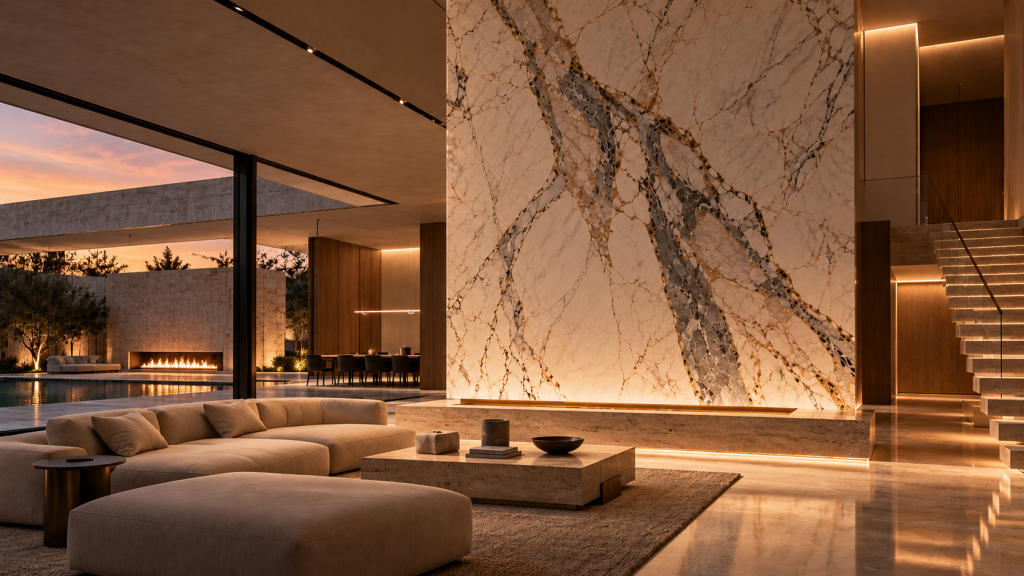
Quick answer: The biggest marble and natural stone trends for 2027 are backlit onyx, travertine, expressive marble with natural movement, honed and textured finishes, sculptural stone, warm natural palettes, and one statement stone used with restraint. For Dubai, we believe backlit onyx and travertine will matter most: onyx because it turns stone into a light source, and travertine because it brings warmth and texture to villas, hotels and outdoor spaces.
Key takeaways
- Luxury stone design is moving away from polished perfection and towards warmth, texture and individual character.
- Backlit onyx is becoming an architectural lighting feature, used in fewer places but with more impact.
- Travertine is the leading warm stone for floors, walls, staircases and terraces, with vein-cut and cross-cut options for very different looks.
- Honed, brushed and leathered finishes are gaining ground on high polish, partly because they handle strong sunlight better.
- Marble is chosen slab by slab for its movement and colour, and placed where it can be the focal point.
As we look towards 2027, architects and designers are choosing natural stone differently. For years, luxury interiors in Dubai leaned on bright white marble and mirror-polished surfaces. Today, the strongest projects favour stone that feels warmer, more tactile and more individual.
Stone is no longer only a finish applied to a wall or floor. It is becoming part of the architecture, shaping a space through texture, light, colour and form. Below are the seven trends we expect to define luxury natural stone in 2027, and what each one means for projects in Dubai.
A note on terms: in the stone trade, “marble” is often used loosely for polished decorative stone. Travertine is a type of limestone formed by mineral springs, and the onyx used in interiors is usually a banded, translucent calcite. All three are covered here because they are specified side by side.
1. Backlit onyx: stone becomes light
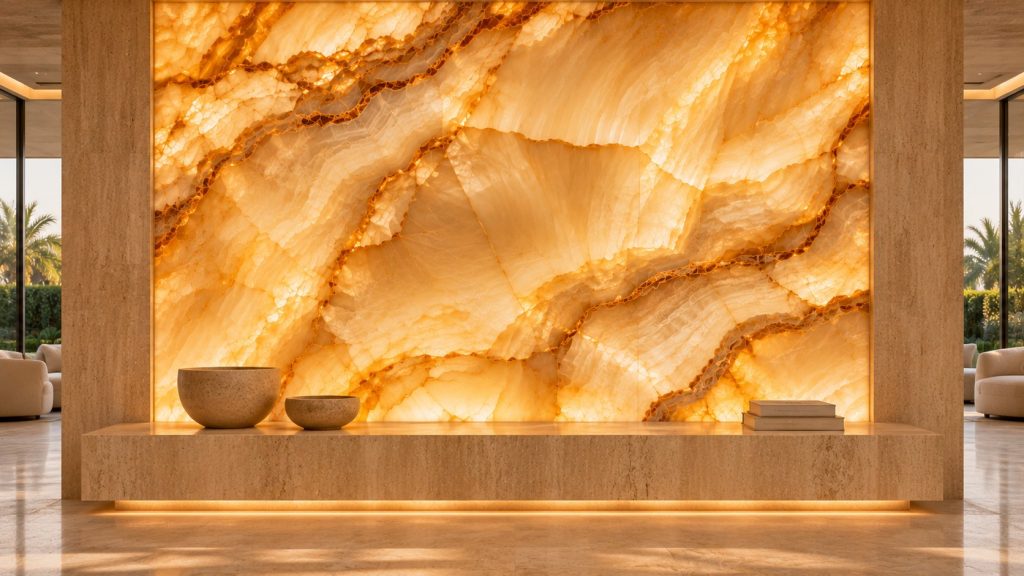
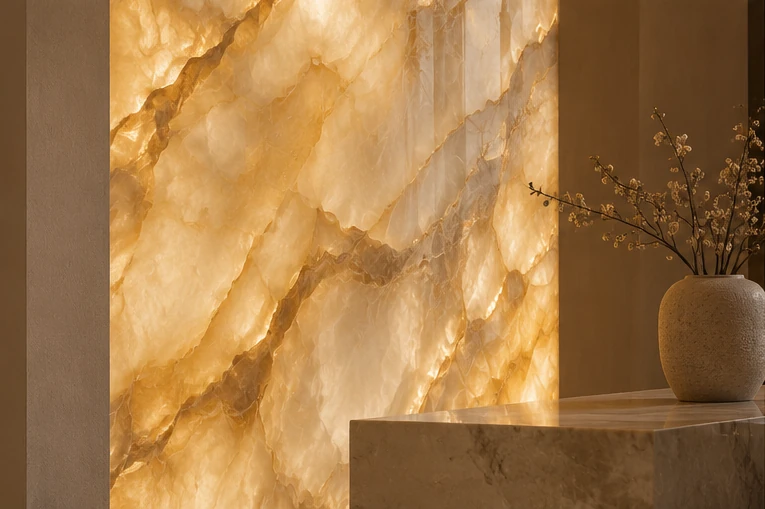
Backlit onyx is a translucent natural stone lit from behind, so light passes through the slab and reveals its veining, banding and colour. We expect it to be one of the defining stone features of luxury interiors in 2027, used as a single focal point rather than across whole rooms.
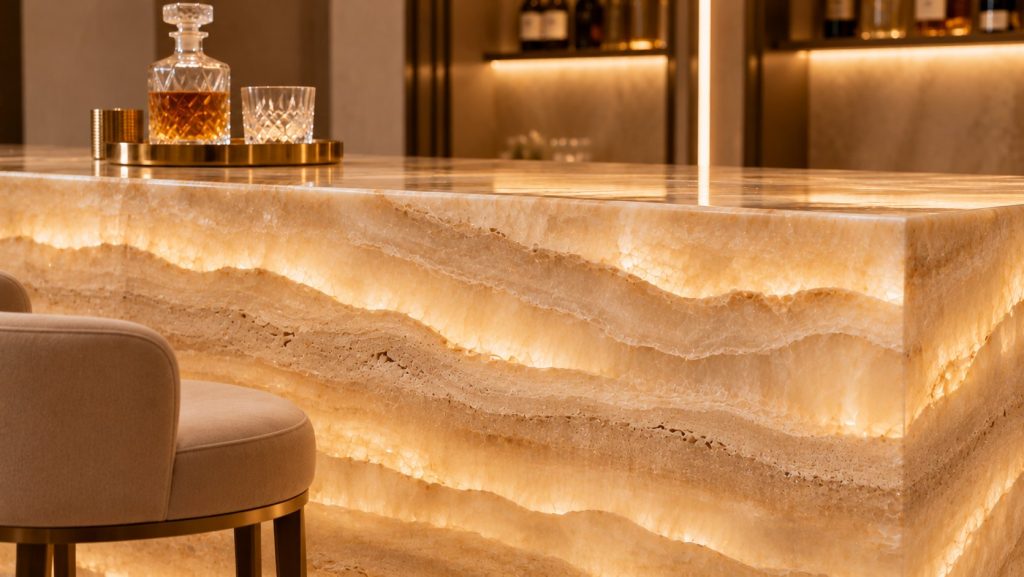
Unlit, onyx can look calm and subtle. Lit from behind, the same slab shows depth and mineral patterns that ordinary lighting never reveals. That makes it as much a lighting decision as a material decision.
Tra-onyx is the softer alternative. Tra-onyx sits between travertine and onyx: it has the layered, horizontal banding of travertine with part of the translucency of onyx. Backlit, it gives a warmer, calmer glow than classic onyx, which suits villas and hospitality spaces that want light without drama.
Where backlit onyx works best:
- Feature walls and statement panels
- Bar counters and reception desks
- Bathroom vanities and powder rooms
- Majlis and formal reception spaces
- Hotel lobbies, restaurants and lounges
- Niches, decorative panels and bespoke furniture
What to get right when specifying backlit onyx:
- Slab thickness. Onyx for backlighting is commonly around 20 mm. Thinner onyx is often laminated to glass, which adds strength and lets more light through.
- Even light. LED panels or strips should sit far enough behind the stone to avoid hot spots. Uneven light is the most common reason backlit stone disappoints.
- Colour temperature. Warm white light (around 2700K to 3000K) brings out the honey and amber tones of many onyxes. Cooler light suits white and green onyx. Dimmable lighting lets one wall work for both day and evening.
- Access. Plan a way to reach the LEDs for maintenance without removing the stone.
- Placement. Onyx is softer and more delicate than most marble. It belongs on walls, counter fronts and protected surfaces, not on high-traffic floors or in direct outdoor sun.
In Dubai, where evening entertaining and hospitality design put so much weight on atmosphere, a well-lit onyx wall can define an entire room. Explore our onyx stones for backlit projects in Dubai.
2. Travertine: warmth, texture and timeless architecture
Travertine is a warm, naturally porous stone, and we expect it to be the most widely specified warm stone in Dubai’s luxury projects in 2027. Its cream, beige and walnut tones, natural pores and soft variation suit the shift towards warm minimalism.
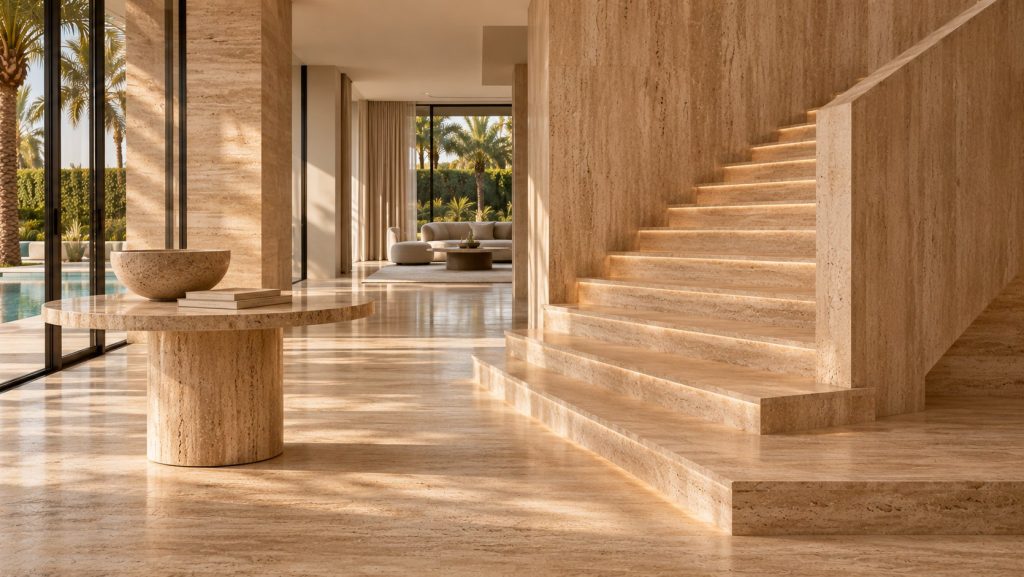
Where travertine is being used:
- Villa flooring, entrance halls and staircases
- Bathroom walls and floors
- Kitchen islands and feature walls
- Outdoor terraces, pool decks and facades
- Sculptural furniture and architectural details
How cut and finish change the look:
- Vein cut (cut along the layers) shows straight, linear bands for a more architectural feel.
- Cross cut (cut across the layers) shows softer, cloud-like patterns.
- Filled travertine has its pores filled with resin or cement for a smooth, easy-clean surface, which suits kitchens and bathrooms.
- Unfilled travertine keeps its open pores for a more natural, textured look, popular on walls and outdoors.
- Honed, brushed and tumbled finishes range from smooth matte to soft and aged.
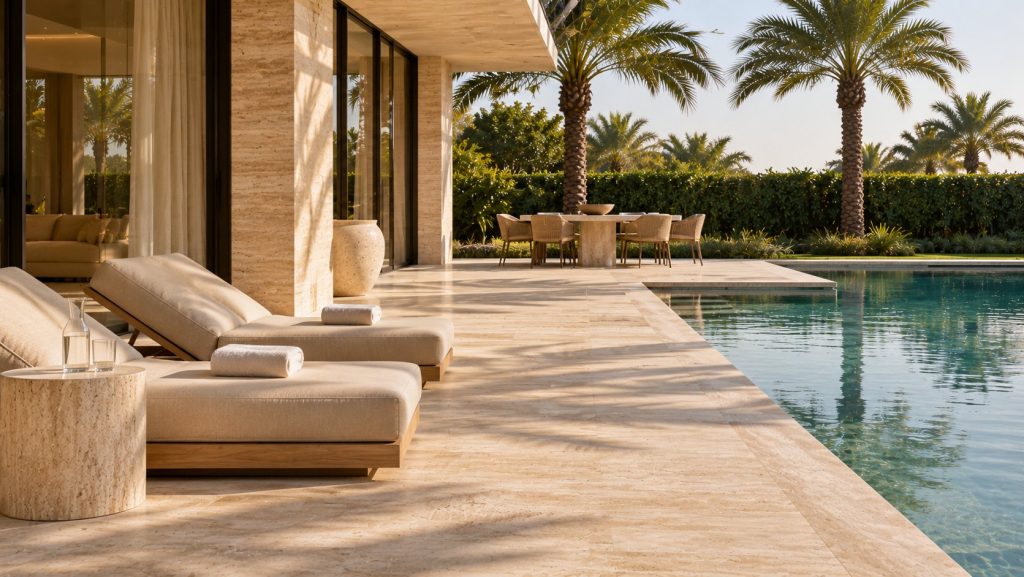
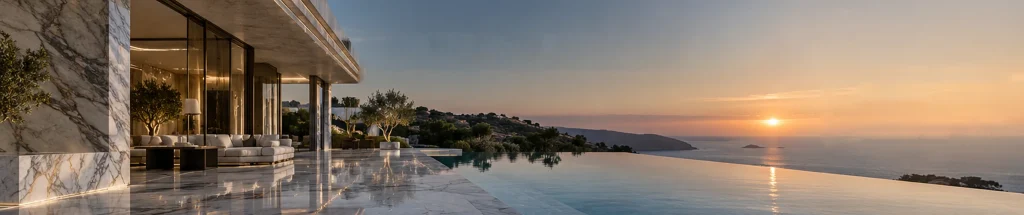
For outdoor use in Dubai, lighter travertine with a non-slip finish is one of the better choices around pools and terraces, because pale stone absorbs less heat. We cover this in detail in our guide to the best natural stone for Dubai’s heat. For pool areas specifically, see travertine pool decks in Dubai.
Indoors, travertine pairs well with natural timber, bronze, brushed brass and textured plaster. The result feels calm and substantial rather than decorative. Explore our travertine range.
3. Marble with character: natural variation takes centre stage
In 2027, marble is being selected for its movement and individuality, not for uniformity. Designers are looking beyond plain white marble towards warm beige and gold tones, green marble, and dramatic brown or burgundy veining.
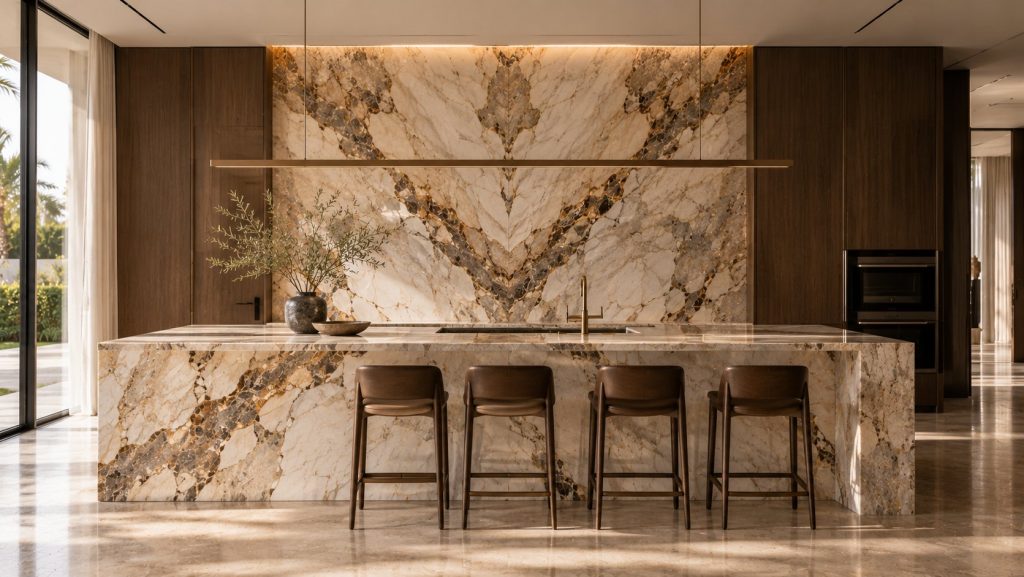
The goal is not the most dramatic slab possible. It is the slab that works with the architecture, the surrounding materials and the natural light. A carefully chosen marble can anchor a kitchen island, a bookmatched wall, a staircase or a bathroom.
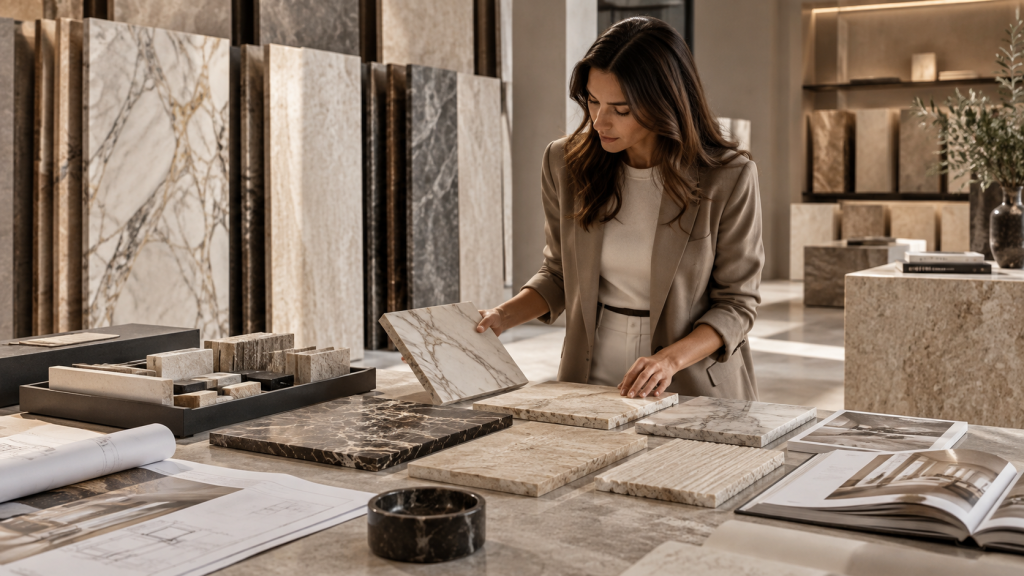
No two slabs are the same, which is exactly the appeal. That is also why we recommend viewing full slabs before committing, as explained in our guide to choosing natural stone slabs for luxury projects. Browse our marble selection.
4. Honed, brushed and leathered finishes
Finish is becoming as important as colour, with honed, brushed and leathered surfaces gaining ground on high polish. The same stone can look completely different depending on its finish.
- Polished: high gloss and deep colour. Still right for statement walls and formal spaces.
- Honed: smooth and matte. Softer, calmer and less reflective.
- Brushed: gently textured with a soft sheen. Adds depth and hides wear.
- Leathered: textured with a subtle sheen. Hides fingerprints and water marks, so it suits kitchen counters.
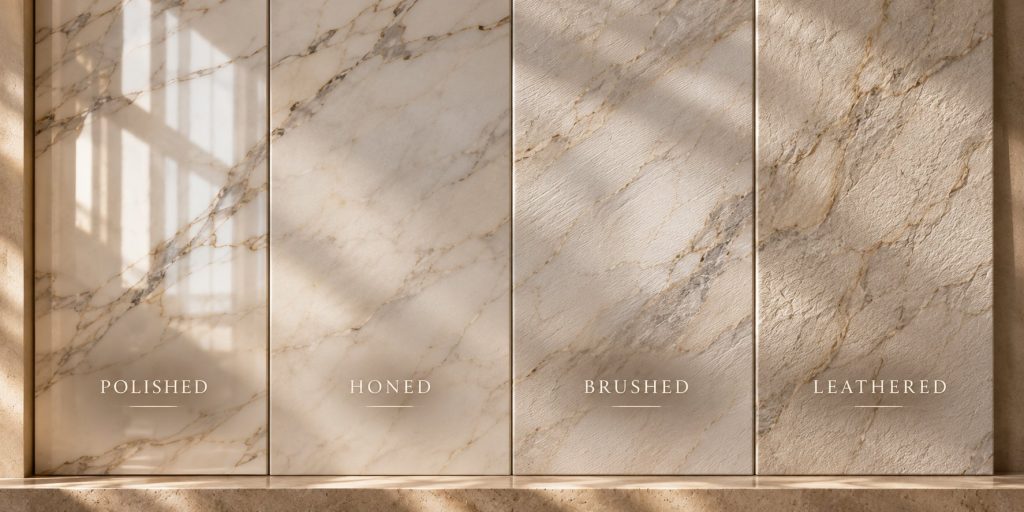
In Dubai’s strong sunlight, matte and textured finishes also reduce glare on floors and large wall surfaces, which is one practical reason they are spreading.
5. Sculptural stone: from surface to architecture
Natural stone is increasingly shaped into objects and architecture, not only used as cladding. Think monolithic kitchen islands, curved travertine walls, bespoke marble vanities and stone consoles.
This approach puts the material first. The strongest designs consider form and stone together from the beginning, rather than choosing a stone after the shape is fixed.
6. Warm natural palettes
Cream, beige, sand, taupe, caramel and warm brown stone are replacing cool greys and stark whites in many luxury interiors. Travertine, limestone, warm marble and selected quartzites all fit this direction.
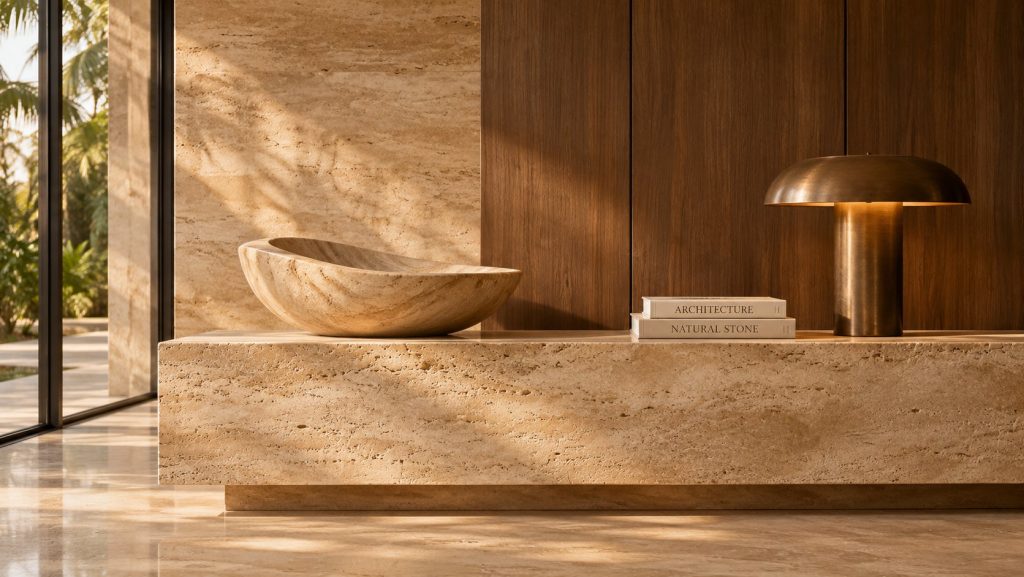
These tones work best layered with natural timber, bronze and brushed brass, linen, textured plaster and warm architectural lighting. Fewer materials are used, but each one has a clearer role. For warm-toned quartzite options, see our luxury quartzite buyer’s guide.
7. One statement stone, used with intention
The most important 2027 trend is not a stone but a way of using it: one statement stone, placed where it matters. Instead of covering every surface in the same material, designers create a few moments of real impact.
That might be a dramatic kitchen island, a bookmatched feature wall, a sculptural staircase, a backlit onyx panel or a carefully designed bathroom. These moments land harder when the surrounding materials let them stand out.
The best stone is not necessarily the most expensive one. It is the stone that is right for the architecture, the light and the way the space will be used.
Onyx vs travertine vs marble: which to use where
| Stone | What makes it different | Best 2027 uses | Outdoor use in Dubai | Finishes to consider |
|---|---|---|---|---|
| Onyx | Translucent, can be backlit | Feature walls, bars, reception desks, vanities | Not recommended | Polished, honed |
| Travertine | Warm tones, natural pores, soft texture | Floors, walls, staircases, terraces, pool decks | Yes, especially lighter tones with a non-slip finish | Honed, brushed, tumbled; filled or unfilled |
| Marble | Expressive veining, widest colour range | Islands, bookmatched walls, bathrooms, staircases | Selected stones only | Polished, honed, leathered |
What do the 2027 marble trends mean for Dubai?
In Dubai, the 2027 direction points to warmer, more tactile stone that is chosen with the climate and the light in mind.
- Strong sunlight makes matte and textured finishes more practical on large surfaces, and favours lighter stone outdoors.
- Evening atmosphere matters in villas, majlis spaces, hotels and restaurants, which is where backlit onyx earns its place.
- Large villa and palace interiors reward careful slab selection and bookmatching, so the stone reads as one continuous design.
- Hospitality projects are using warm stone and integrated lighting to create calm, residential-feeling spaces.
Marble remains central, but selection is becoming more individual, with more attention to movement, colour, finish and placement.
How to specify these trends: a short checklist for architects
- Decide the one or two statement moments before choosing the rest of the palette.
- View full slabs, not small samples, for any marble or onyx feature.
- For backlit onyx, request a lit sample at the planned colour temperature.
- Test finish samples under the project’s real lighting, including daylight.
- Agree bookmatching and slab layout before cutting.
- Confirm outdoor suitability, slip resistance and heat behaviour for terraces and pool decks.
For a fuller process, read our architect’s guide to specifying natural stone.
Discover natural stone with Tenetti
Tenetti works with architects, interior designers, developers and private clients across Dubai to source and select natural stone for residential, hospitality and architectural projects. From travertine and marble to limestone and onyx, our approach is to find the right material for each project.
Start your project, explore our products or WhatsApp us on +971 56 798 6525.
Frequently Asked Questions
The main trends are backlit onyx, travertine, marble with expressive natural veining, honed and textured finishes, sculptural stone, warm natural palettes, and using one statement stone with restraint. The common thread is a move from polished uniformity towards warmth, texture and individual character.
Yes, as a feature rather than a main surface. Backlit onyx suits feature walls, bars, reception desks, vanities and majlis spaces. It needs even LED lighting, a suitable slab thickness or glass lamination, and placement away from high-traffic floors and direct outdoor sun.
Tra-onyx is a natural stone that combines the layered, banded structure of travertine with some of the translucency of onyx. It can be backlit for a soft, warm glow and is used for feature walls, bars, vanities and decorative panels.
Yes. Lighter travertine with a non-slip finish, such as tumbled or brushed, is a good option for terraces and pool decks, because pale stone absorbs less heat than dark stone. Unfilled or sealed travertine is usually chosen outdoors.
Vein-cut travertine is cut along the stone’s layers and shows straight, linear bands. Cross-cut travertine is cut across the layers and shows softer, cloud-like patterns. The stone is the same; only the cutting direction changes.
No, but it is used more selectively. Polished marble remains a strong choice for statement walls and formal spaces, while honed, brushed and leathered finishes are growing for floors, kitchens and large surfaces.
Price depends on the stone, its origin, slab size, thickness, finish and quantity. Our 2026 price guide for luxury natural stone in Dubai breaks down the main cost factors.