Ask a stone supplier in Dubai “how much does marble cost?” and the honest answer is: it depends. A square metre of natural stone can cost less than a good dinner or more than a designer handbag. Both are marble. The difference comes down to rarity, slab quality, how the stone is cut and matched, and how carefully it is installed.
This guide explains what luxury natural stone really costs in Dubai in 2026, what drives the price up or down, and how to budget a high-end project without unpleasant surprises. It is written for architects, developers and homeowners working on villas, hotels and premium residential projects.
Quick answer: premium natural stone for luxury projects in Dubai typically costs from around AED 600 to AED 1,500 per square metre for the material alone, while exceptional stones such as top-grade Calacatta, rare quartzites and translucent onyx can exceed AED 1,500 to 4,000 per square metre. Fabrication, matching waste and installation are added on top, and on a complex feature they can equal or exceed the cost of the stone itself.
Why natural stone prices vary so much
Natural stone is not manufactured to order. Every block comes out of a specific quarry face, and no two blocks are identical. A quarry may produce thousands of square metres of a commercial beige marble each month, but only a handful of blocks of a pure white Calacatta with the bold, balanced veining that designers want for a feature wall.
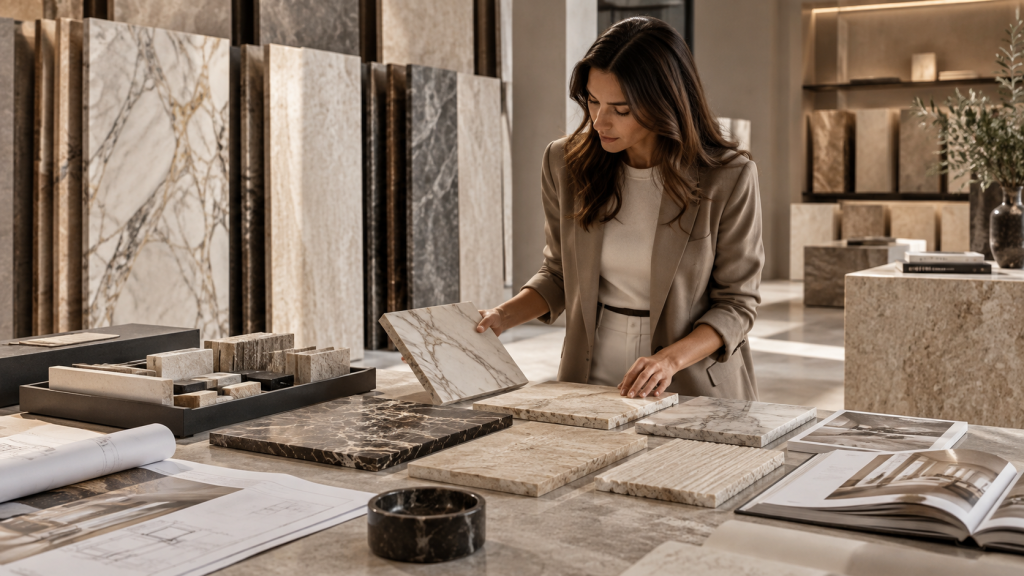
Price follows that scarcity. Two slabs sold under the same name can differ in price by a factor of three or more, depending on background colour, veining, the number of defects and the size of the slab. That is why a price list alone tells you very little, and why the selection process matters as much as the stone name. Our guide on how to choose natural stone slabs goes deeper into slab quality.
Indicative price tiers for 2026
The table below groups natural stone into three broad tiers. Prices are indicative ranges for the slab material per square metre in the UAE market, before fabrication, waste and installation. Actual prices depend on the specific block, quantity and current availability.
| Tier | Typical stones | Indicative material price (AED per m²) |
|---|---|---|
| Classic | Crema Marfil, Light Emperador, Botticino, standard Carrara, classic travertine and limestone | 250 to 600 |
| Premium | Statuario, Calacatta grades, Arabescato, Volakas, Nero Marquina, premium travertine and limestone, honey and white onyx, selected quartzites | 600 to 1,500 |
| Exceptional | Top-grade Calacatta Oro and Borghini, Calacatta Viola, rare exotic quartzites, highly translucent onyx, book-matched feature sets | 1,500 to 4,000+ |
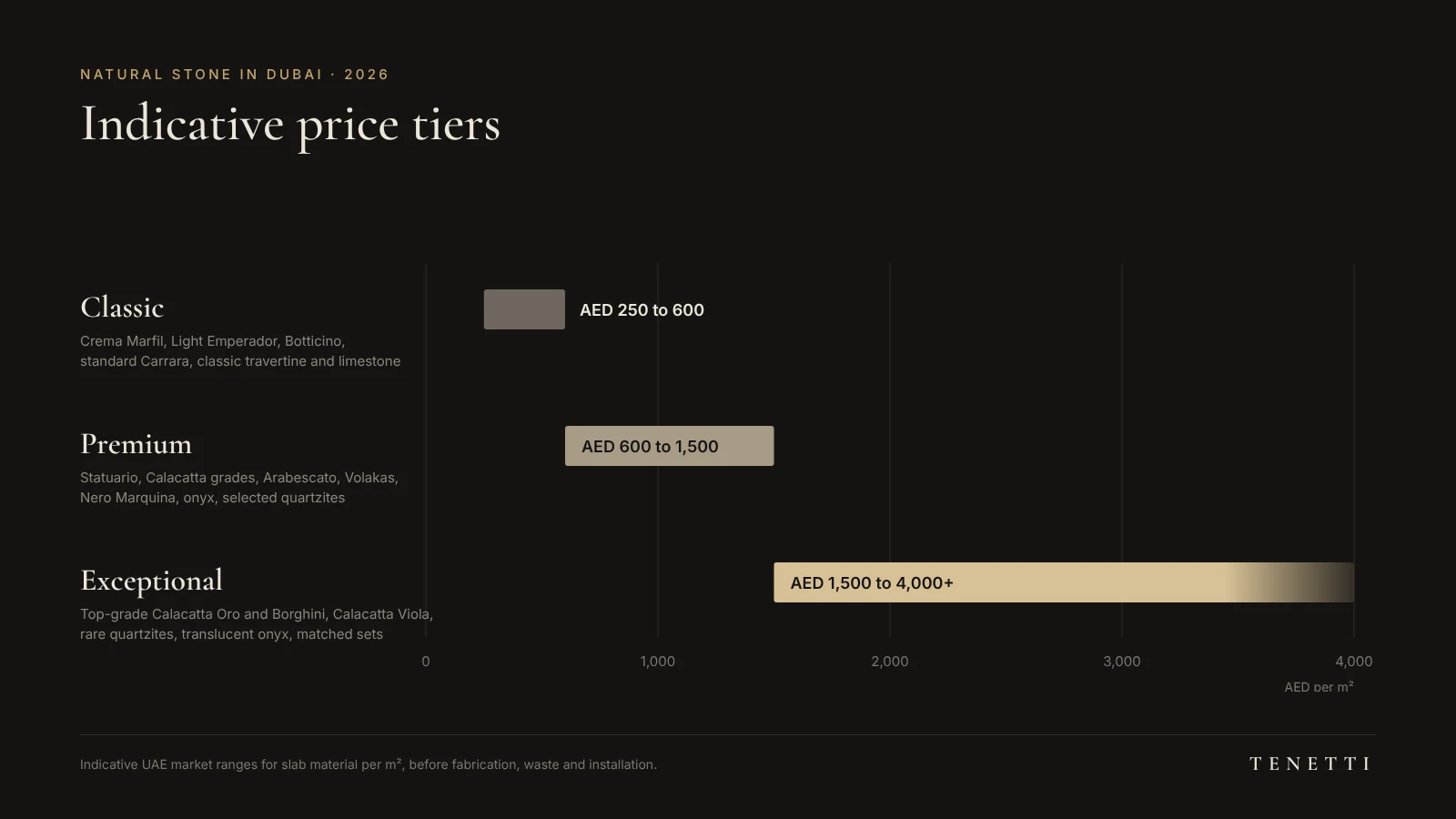
Most luxury villa and hospitality projects use a mix of tiers. A premium or exceptional stone is often reserved for the moments people notice, such as an entrance, a feature wall or a statement bathroom, while a classic stone covers larger floor areas.
What drives the price of a natural stone project
1. Rarity and quarry output
The single biggest factor. Stones from small or nearly exhausted quarries, or with unusual colours such as the deep burgundy veins of Calacatta Viola, command a premium because supply is limited and demand from luxury projects worldwide is high.
2. Slab grade and selection
Within one stone, slabs are graded by background colour, consistency of veining, and the number of cracks, resin fills and spots. First-choice slabs from the best part of a block can cost far more than commercial grades of the same stone. For a large project, reserving consistent slabs from the same block also matters, so the floor does not change character from room to room.
3. Thickness and format
Most interior applications use 2 cm slabs, while kitchen countertops, stair treads and some exterior cladding often use 3 cm. Thicker material costs more per square metre and weighs more to transport and install. Large-format slabs with fewer joints also cost more than standard tiles cut from the same stone.
4. Finish
Polished is the standard. Honed, brushed, leathered or flamed finishes add processing steps, and textured finishes on hard stones such as quartzite take longer to produce. For outdoor areas and pool decks, slip resistance should drive the choice rather than looks alone.
5. Matching and waste
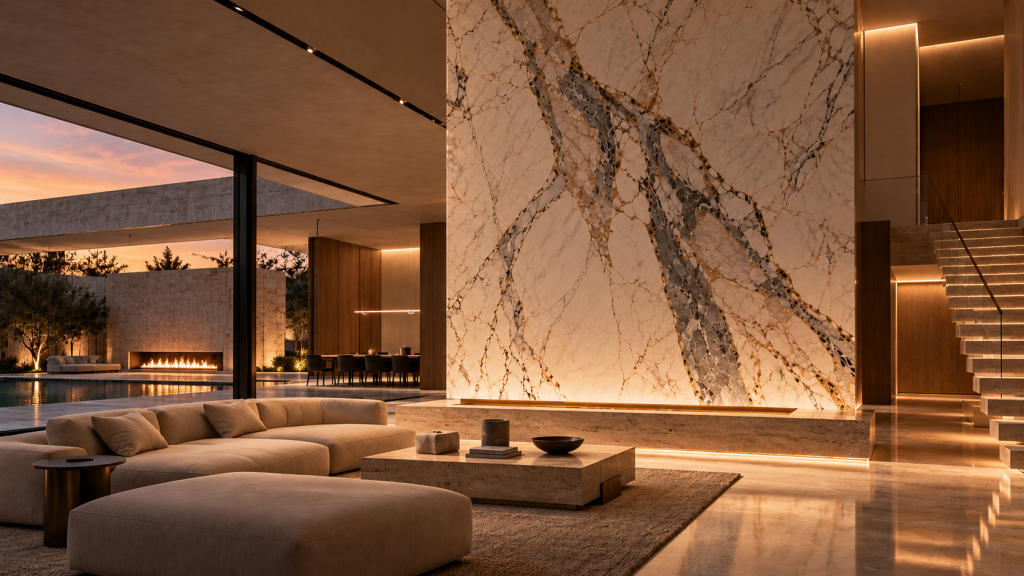
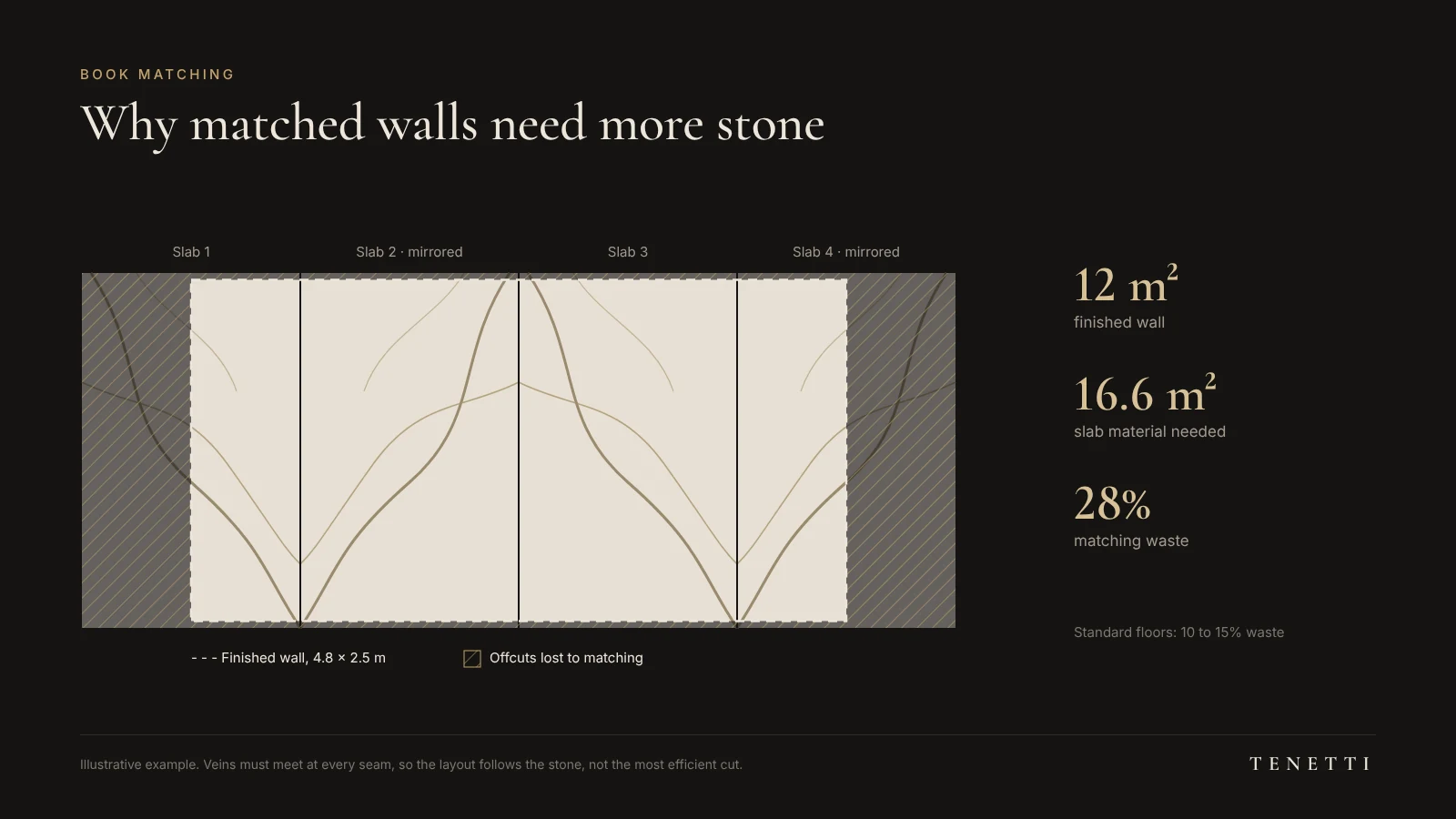
This is where budgets are most often underestimated. A book-matched or vein-matched wall needs consecutive slabs from the same block, and the layout is planned around the veining rather than around the most efficient cut. Waste of 10 to 15 percent is normal on standard floors, but 20 to 35 percent is common on matched feature walls and complex patterns.
6. Fabrication and detailing
Mitred edges, shaped profiles, integrated sinks, inlays, carved elements and water jet patterns all add workshop hours. Bespoke pieces such as fountains, columns or medallions are priced individually and can be a significant share of a project budget.
7. Installation
Skilled installation is not where to economise. Proper substrate preparation, the right adhesive for the UAE climate, movement joints and careful handling of large slabs all take time. A poorly installed premium stone looks worse, and fails sooner, than a well installed classic one. Sealing should also be planned from the start, as covered in our marble waterproofing and sealing guide.
8. Logistics and timing
Stone from European quarries travels in crated containers, and the cost of freight, insurance and handling is part of the landed price. Urgent orders, air-freighted samples or last-minute replacements always cost more than a project planned with realistic lead times.
An illustrative example: a book-matched feature wall
To show how these factors add up, consider a 12 m² book-matched marble wall in a villa living room. The numbers below are illustrative only, to show the structure of a budget rather than a quote.
- Wall area: 12 m², for example 4.8 by 2.5 metres
- Slab material needed: about 16.6 m² from four consecutive slabs, so roughly 28 percent is lost to matching
- Stone: a premium Calacatta at an indicative AED 1,800 per m², giving AED 21,600 for the wall itself plus AED 8,280 for the matching waste
- Fabrication: cutting to the matched layout, edge details and dry lay approval, around AED 3,600
- Installation and sealing: fixing system suited to the wall plus sealing, around AED 4,200
- Total: about AED 37,680, or roughly AED 3,140 per m² of finished wall
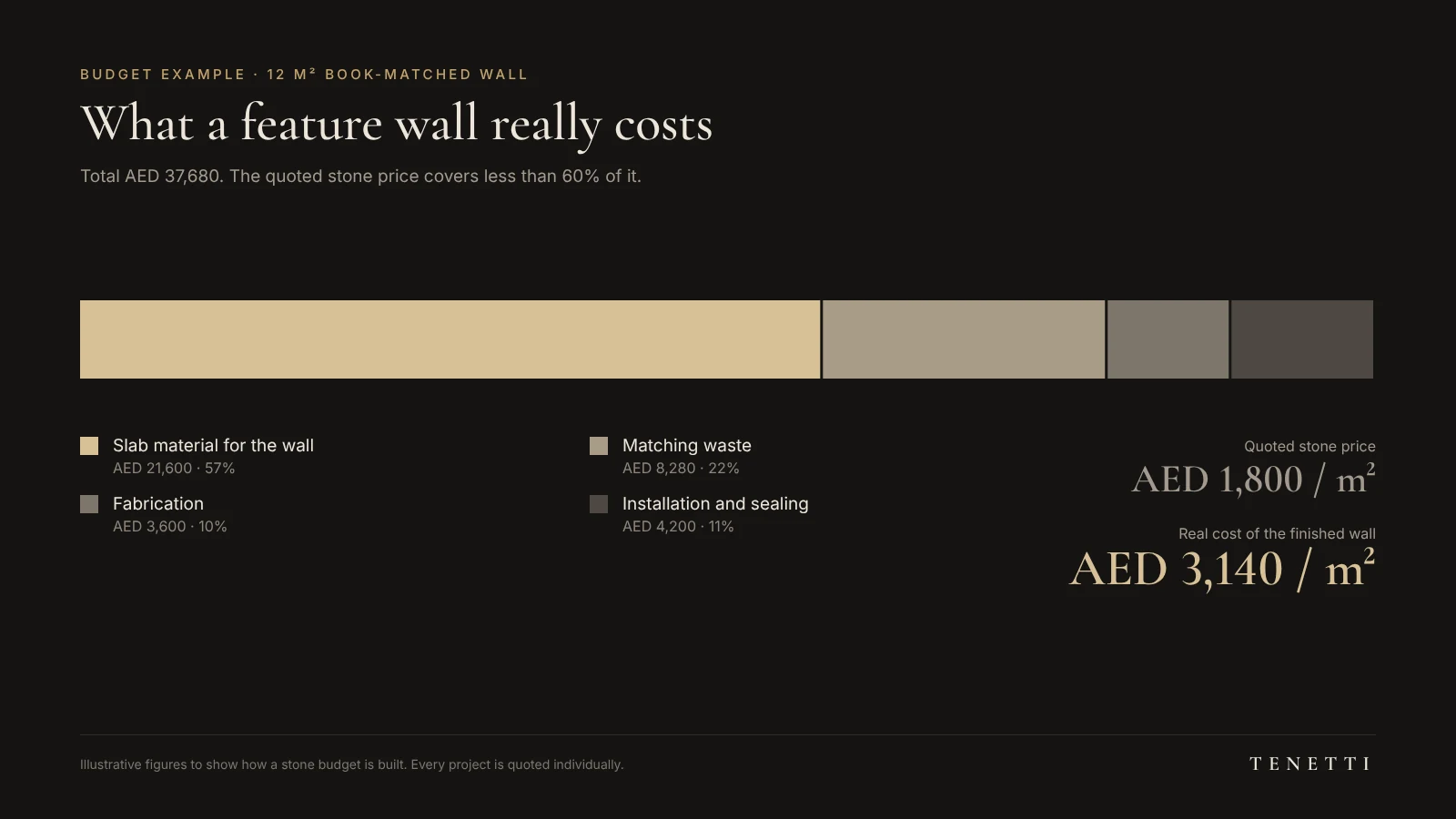
In this example the material is the largest single cost, but waste alone adds more than a third to it, and the quoted stone price of AED 1,800 per m² ends up as just over half of the real cost. On a smaller, more complex piece, fabrication and installation can overtake the stone itself. This is why comparing quotes on price per square metre alone can be misleading.
Where to spend, and where to save
A good stone budget puts money where it is seen and touched, and is pragmatic elsewhere.
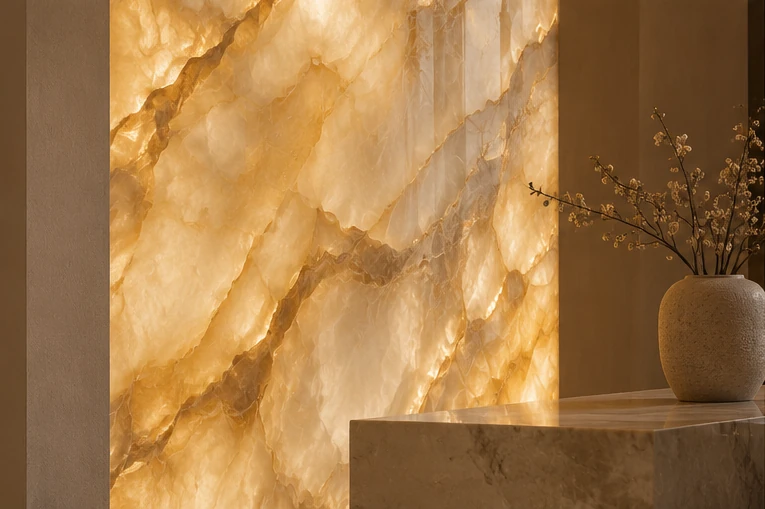
- Spend on entrance halls, feature walls, master bathrooms, kitchen islands and anywhere the stone is viewed up close or lit dramatically, such as backlit onyx features.
- Spend on skilled installation and proper matching, because they decide whether an expensive stone actually looks expensive.
- Save on large secondary floor areas, utility spaces and back-of-house, where a classic stone performs just as well.
- Save on unnecessary thickness. A 2 cm slab is right for most interior walls and floors.
- Save on changes after ordering. Revising layouts once slabs are cut is one of the most expensive mistakes on any stone project.
Red flags in a quote that looks too good
A low price per square metre is not always a saving. Before accepting a quote, check whether it includes:
- The actual grade of slab, ideally with photos of the specific slabs or block
- A realistic waste allowance for the layout, especially for matched walls
- Fabrication of edges, cut-outs and details, rather than raw slabs only
- Installation, adhesives or fixings, and sealing
- Delivery to site, handling and protection during construction
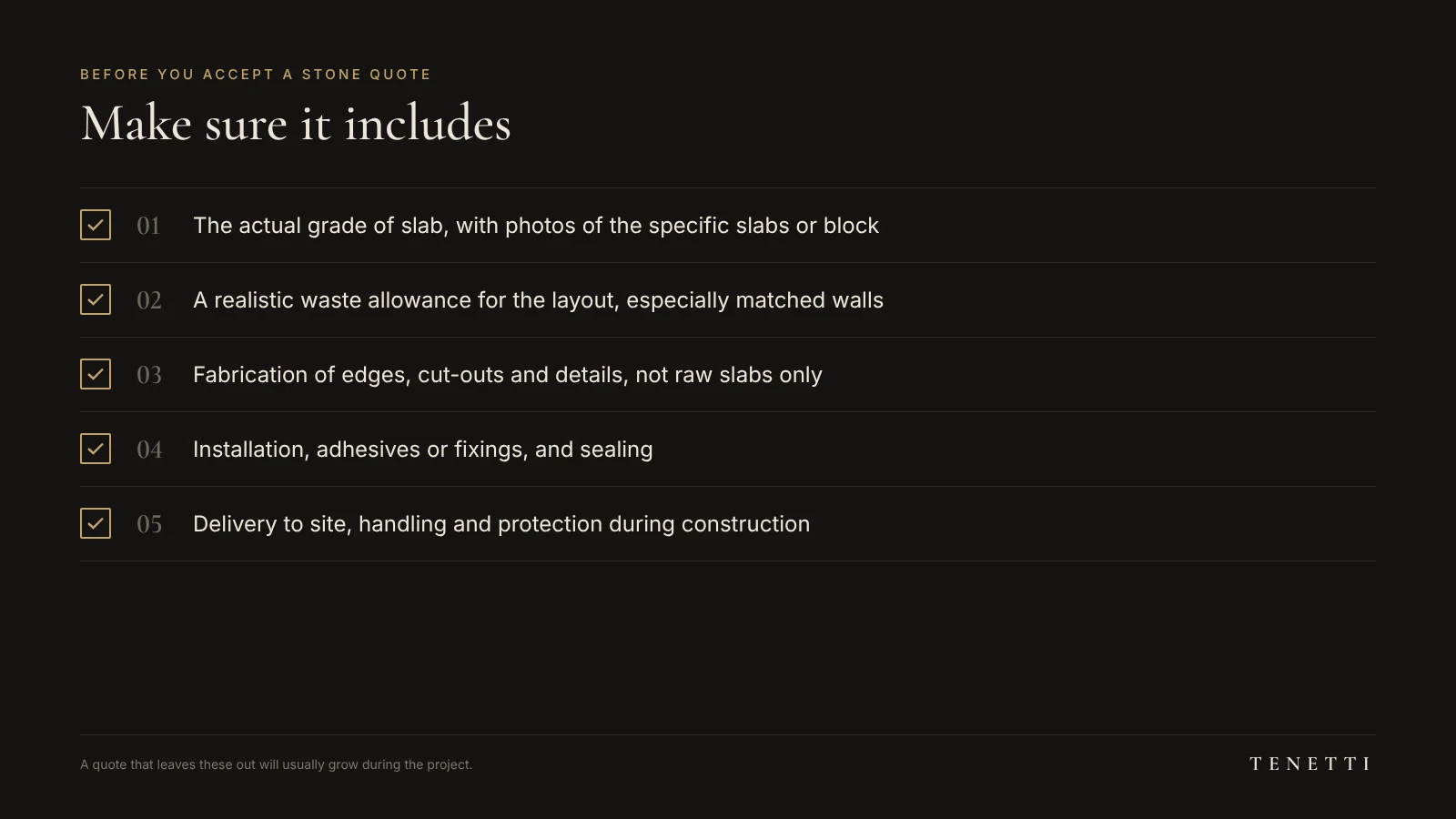
A quote that leaves these out will usually grow during the project. A quote that includes them is easier to compare and far less likely to surprise you later.
How to get an accurate price
The more precise the brief, the more precise the price. Share drawings or measurements, the intended use of each area, reference images or preferred stones, required finish and thickness, and your timeline. If you are still choosing between materials, our luxury marble buyer’s guide and quartzite buyer’s guide are good places to start. For architects preparing a specification, see our guide to specifying natural stone.
At Tenetti we work from quarry to installation, so we can price the complete scope rather than the slab alone, and show you the actual material before it is cut.
Frequently asked questions
Is natural stone more expensive than porcelain or engineered stone?
Usually yes at the premium end, but the comparison is not like for like. Natural stone is unique, can be refinished over decades and adds lasting value to a property. We compare the options in detail in natural stone vs artificial materials.
Why is Calacatta so much more expensive than Carrara?
Both come from the Carrara region in Italy, but Calacatta has a whiter background and bolder veining and is far rarer. Top grades are among the most expensive marbles in the world. Our comparison of Calacatta vs Statuario explains the differences between the premium Italian whites.
Do prices change during the year?
Prices follow quarry output, demand and freight costs. Rare stones can rise quickly when a quarry slows production or a sought-after block sells out, so reserving slabs early is wise on large projects.
Can I see the actual slabs before ordering?
For premium and exceptional stones you should. Approving specific slabs, either in person or through detailed photos and a dry lay of the matched layout, is the best protection against surprises.
Planning a project? Share your project details and our team will come back with stone options and a complete, transparent price.