Quick answer: The best natural stone for Dubai heat is light coloured travertine or dense light limestone. Both reflect more sunlight, stay more comfortable underfoot than dark stone, and take textured, non-slip finishes well. Light marble works outdoors too if it has a honed, brushed or sandblasted finish. Onyx belongs indoors. Dark stones such as black granite and dark slate absorb the most heat, so avoid them on any surface people walk on barefoot.
Dubai summers regularly pass 45°C, and surfaces in direct sun get much hotter than the air. Pick the wrong stone or the wrong finish for a pool deck, terrace or facade, and you get something too hot to stand on, slippery when wet, or patchy after two summers. This guide answers the questions architects, designers and villa owners ask us most often.
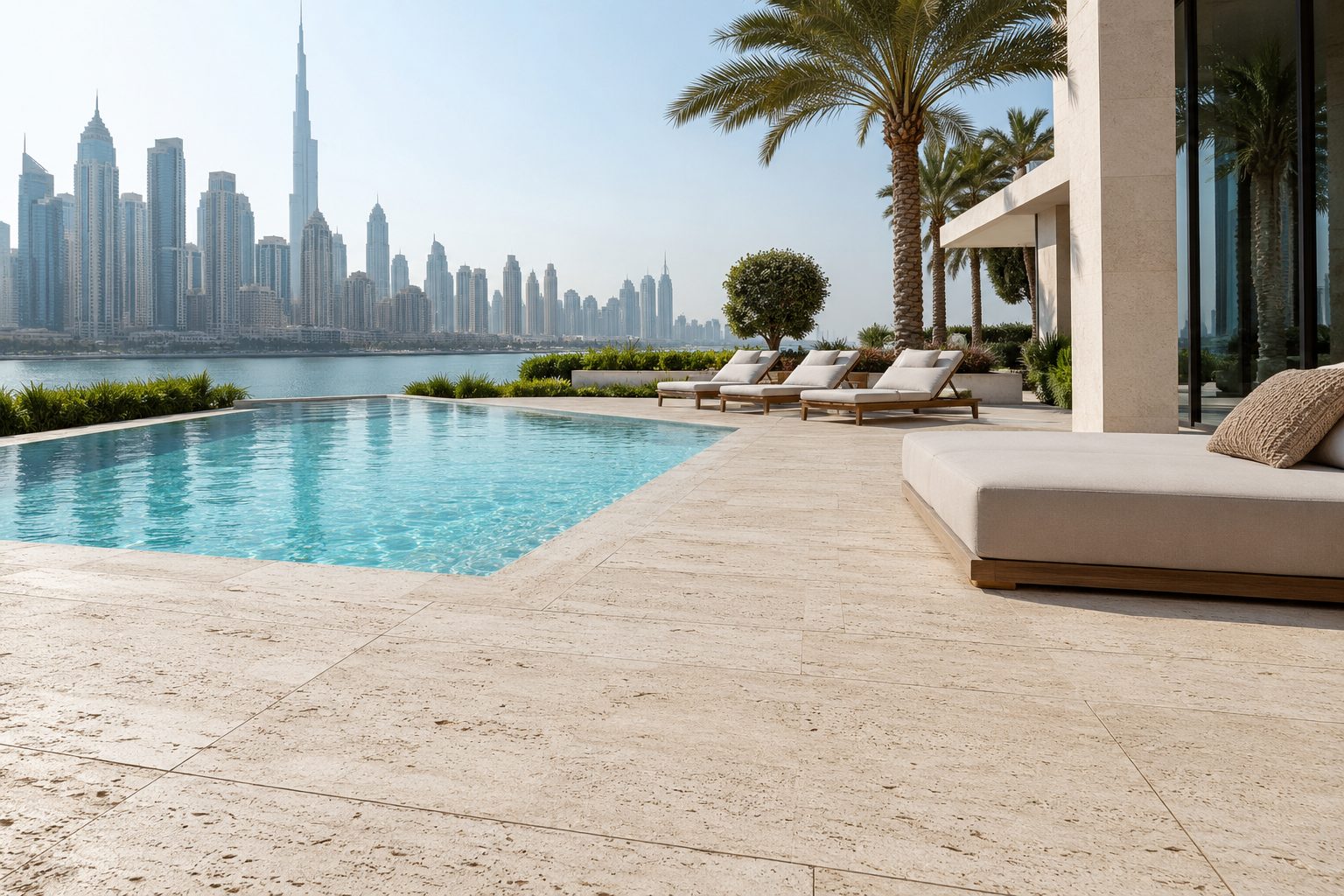
Which is the best natural stone for Dubai heat?
When you look for the best natural stone for Dubai heat, colour matters most, then finish, then the stone itself. In short, light stones reflect more of the sun’s energy and absorb less of it. Ivory travertine, cream limestone and white marble all stay noticeably cooler than grey, brown or black stone in the same spot.
Texture helps as well. For example, a brushed, tumbled or sandblasted surface has less skin contact than a smooth one, so it feels more comfortable when you walk on it. Likewise, porous stones such as travertine tend to release heat more gently than very dense, dark stones.
Of course, no stone stays cold at 3 pm in August. Instead, the goal is a surface that stays comfortable enough to walk on, and that comes down to a light colour with a textured finish.
Does travertine get hot in Dubai?
Light travertine warms up in direct sun but stays one of the most comfortable natural stones underfoot. For this reason, it is the classic choice for pool decks across the Gulf and the Mediterranean. Its natural pores and matt surface keep it far cooler to the touch than dark stone or polished finishes.
For outdoor use in the UAE, choose:
- Light tones such as Ivory, Classico or light Silver travertine.
- A brushed or tumbled finish, never polished.
- Unfilled or cement-filled travertine outside. Resin fillers can discolour and break down under strong UV over time.
- 30 mm thickness or more for pavers and pool copings.
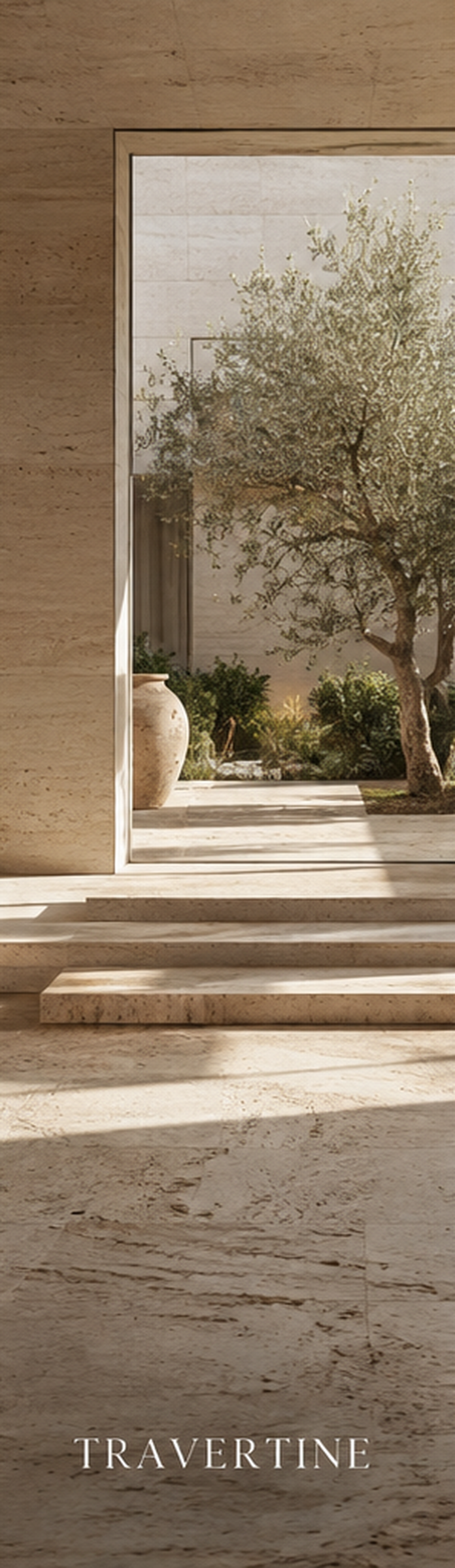
See our full guides to travertine and travertine pool decks.
Is marble good for outdoor use in the UAE?
Yes, if you choose the right marble and finish it correctly. Generally, light, dense marbles handle UAE sun well and keep a cool, bright look. However, polished marble is a problem. Outside, the polish wears away under sand and foot traffic, and when it is wet it becomes slippery.
For terraces, walkways and pool surrounds, specify marble with a honed, brushed, sandblasted or bush-hammered finish. Meanwhile, keep polished marble for shaded, covered or indoor areas. Marble is also a calcium-based stone, so it reacts with acids, including some pool chemicals and cleaning products. As a result, sealing and the right cleaners matter. Our marble waterproofing and sealing guide explains how.
Is limestone a good choice for Dubai facades and terraces?
Dense, light limestone is one of the best stones for Dubai facades. Cream and beige limestones reflect sunlight, keep buildings visually calm in strong light, and suit both contemporary and classical villa architecture. That is why so many villas in Dubai Hills, Jumeirah and on Saadiyat Island use it.
However, the key word is dense. Softer, highly porous limestones can absorb moisture, stain and weather faster in humid coastal air. For exterior work, ask your supplier for the stone’s water absorption and density figures, and choose a stone tested for exterior use. The Natural Stone Institute publishes useful guidance on exterior stone selection.

Find out more on our pages for limestone facades and stone cladding in Dubai.
Can onyx be used outdoors in Dubai?
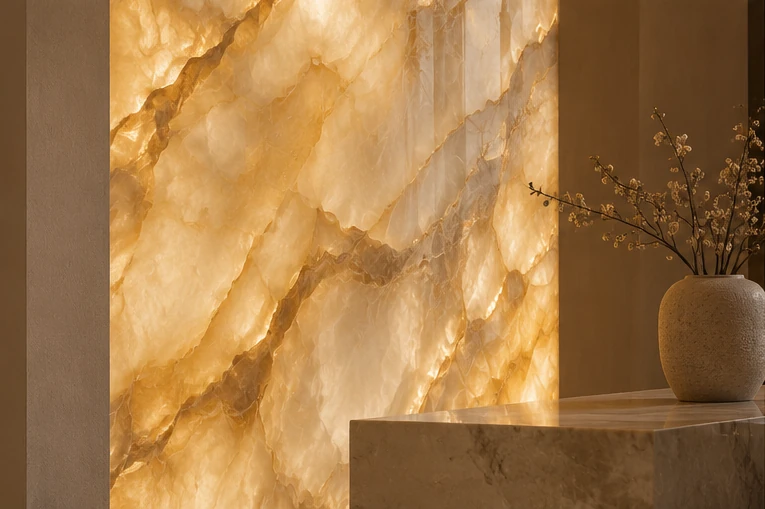
We do not recommend onyx in direct sun. Onyx is softer and more delicate than marble, scratches more easily, and strong UV and weather can dull and change its surface over time. In fact, its real strength is light passing through it, and that only works indoors.
Therefore, use onyx where it can shine: backlit bar counters, feature walls, reception desks and bathrooms in shaded, climate-controlled spaces. Explore our onyx collection.
Which stones should you avoid outdoors in Dubai?
In particular, avoid these on any surface people walk on in direct sun:
- Black or very dark granite, basalt and slate. They absorb the most heat and can become too hot to touch.
- Any polished stone near water. Polished surfaces are slippery when wet.
- Resin-filled travertine in full sun, because the filler can yellow and degrade.
- Soft, very porous stones on coastal sites, where salt air and humidity speed up weathering.
That said, dark stone can still work outdoors as vertical cladding, in shade, or as small accents. It just doesn’t belong on a sun-facing pool deck.
Which stone finish is best for hot, sunny areas?
| Finish | How it feels in heat | Slip resistance when wet | Best for |
|---|---|---|---|
| Polished | Smooth, more skin contact | Low | Indoor floors, walls, vanities |
| Honed | Matt, softer feel | Medium | Covered terraces, shaded walkways |
| Brushed | Textured, comfortable underfoot | Good | Pool decks, terraces, steps |
| Tumbled | Soft edges, aged look | Good | Pool surrounds, garden paths |
| Sandblasted or bush-hammered | Rough, grippy | Very good | Ramps, pool edges, wet zones |
For wet outdoor areas, ask for slip resistance test results (for example a ramp test R rating or a pendulum test value) for the exact stone and finish. After all, the same stone can test very differently depending on its finish.
Will the best natural stone for Dubai heat still fade or crack?
Most light natural stones are colour stable in sunlight, because their colour comes from minerals formed over millions of years, not from dyes. Some strongly coloured stones that contain iron-rich minerals can shift tone slightly over many years outdoors. When in doubt, ask to see an exterior sample that has already been exposed to sun.
On the other hand, cracking is usually caused by installation, not by the stone itself. This is because stone expands in heat and contracts when it cools. In addition, Dubai surfaces swing a lot between midday and night, and when cold pool water or irrigation hits hot stone. Proper movement joints, the right adhesive or mechanical fixing, a well-prepared base and enough thickness prevent most heat-related cracking.
How do humidity, salt air and sand affect outdoor stone?
Coastal humidity, salt in the air and fine sand are just as tough on stone as heat. For instance, salt and moisture can enter porous stone and cause staining or surface flaking over time. Similarly, wind-blown sand slowly wears down soft or polished finishes.
To protect stone on sites like Palm Jumeirah, Jumeirah Bay or Saadiyat Island:
- Choose denser stones with low water absorption.
- Use a breathable, penetrating sealer, not a film-forming coating that can peel or trap moisture.
- Rinse pool surrounds regularly with fresh water to wash away salt and chlorine.
- Re-seal on a schedule your supplier recommends for your stone.
How thick should outdoor stone be in Dubai?
As a general guide:
- Wall cladding: 20 mm minimum for flat panels, 30 mm or more for fluted or grooved panels, mechanically fixed on taller facades.
- Pavers on a bonded base: 20 to 30 mm.
- Pool copings and steps: 30 mm or more, often with a thicker bullnose edge.
- Areas with vehicle traffic: thicker again, as specified by your engineer.
Above all, follow the project specification and your structural engineer’s requirements. These figures are a starting point, not a substitute for design.
How can you keep a stone pool deck cooler?
Choose a light stone with a textured finish, and then let design do the rest. First, shade from pergolas, trees or sails cuts surface heat a lot. Also, a quick rinse with water cools stone fast in the evening. Keeping dark stone to borders and accents, rather than the main walking areas, helps too.
Best natural stone for Dubai heat: quick comparison
| Stone | Heat underfoot (light tones) | UV stability | Best outdoor uses in the UAE | Watch out for |
|---|---|---|---|---|
| Travertine | Very comfortable | Good | Pool decks, terraces, copings, cladding | Resin fillers in sun, polished finish outdoors |
| Limestone (dense) | Comfortable | Good | Facades, cladding, shaded terraces | Soft or very porous types on the coast |
| Marble (light) | Comfortable when textured | Good | Terraces, walkways, feature cladding | Polished finish outside, acids and pool chemicals |
| Onyx | Not recommended outdoors | Weak | Indoor backlit features only | Sun, weather, scratching |
| Dark granite or slate | Gets very hot | Good | Shaded areas, vertical accents | Sun-facing floors and pool decks |
Checklist: choosing the best natural stone for Dubai heat
- Is the area in full sun, part shade or covered?
- Will people walk on it barefoot?
- Will it get wet from a pool, irrigation or rain?
- Is the site coastal?
- Have you seen the actual stone and finish as a sample, ideally outdoors?
- Do you have test data for water absorption, density and slip resistance?
- Is the thickness right for the use?
- Is there a sealing and maintenance plan?
If you can answer all eight, you are ready to specify. If not, we can help. Ultimately, the best natural stone for Dubai heat is the one that suits your exact site, finish and use. You can also read our guide to natural stone prices in Dubai when you start budgeting.
Choosing stone for a Dubai project? Talk to Tenetti
Tenetti produces and supplies luxury natural stone from our own production in Spain and Portugal and from carefully selected quarries worldwide, and we deliver to projects across the UAE. We can recommend the right stone and finish for each area of your villa, hotel or development, send samples, and share technical data for your specification.
Contact our team or WhatsApp us on +971 56 798 6525 to discuss your project.
Frequently Asked Questions
Light travertine and dense light limestone. Light marble with a textured finish also works well.
Light travertine warms up but stays far cooler underfoot than dark stone or polished surfaces.
Not where people walk. It gets slippery when wet, so use honed, brushed or sandblasted marble.
Dark stones such as black granite, basalt and dark slate absorb the most heat.
Both can work. However, light natural stone offers more character and stays comfortable underfoot.
Most light stones keep their colour. Resin fillers and some sealers change more than the stone itself.
Brushed, tumbled or sandblasted finishes. Avoid polished stone near water.
We don’t recommend it. Onyx looks best indoors, especially backlit.
Usually every one to three years with a breathable, penetrating sealer, depending on the stone.
Yes. We supply travertine, limestone, marble and architectural stone across Dubai, Abu Dhabi and the UAE.