
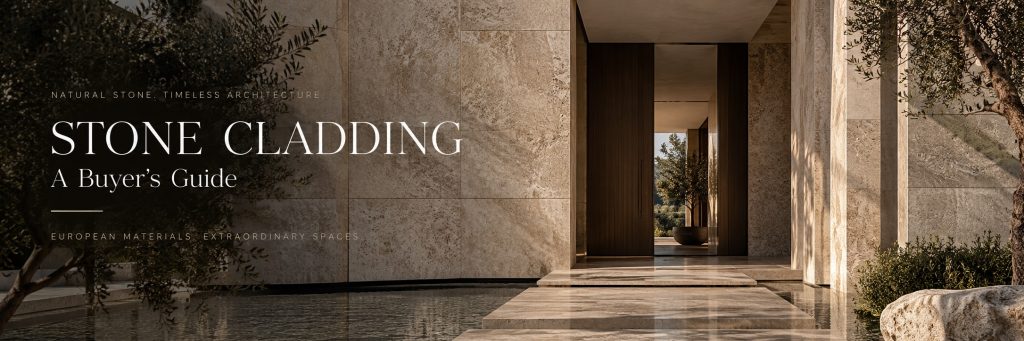
Stone Cladding in Dubai: European Natural Stone for Ultra-Luxury Projects
Stone cladding can completely change the character of a building. Used correctly, natural stone can give a villa, hotel, entrance, façade or interior a sense of permanence, depth and architectural quality that is difficult to achieve with manufactured materials.
But premium stone cladding is not simply about selecting a beautiful stone. The stone, format, finish, thickness, fixing system, detailing, orientation and installation all need to work together.
At Tenetti, we specialise in sourcing and supplying premium European natural stone for luxury projects in Dubai. Our focus is on working closely with architects, designers, developers and contractors to find the right material for the architecture — from European quarries and suppliers directly to projects in the UAE.
What Is Natural Stone Cladding?
Natural stone cladding is the application of natural stone to a building or architectural surface. Depending on the project, stone can be used on both exterior and interior surfaces, including:
- Villa façades
- Entrance walls
- Boundary walls
- Feature walls
- Hotel façades
- Reception areas
- Staircases
- Courtyards
- Pool areas
- Fireplace walls
- Interior architectural features
Stone cladding can be used across an entire building or selectively to highlight particular architectural elements. The objective is not always to use more stone — often, the most sophisticated result comes from using the right stone in the right places.
Why Natural Stone Cladding Works So Well in Luxury Architecture
Natural stone has something that manufactured materials cannot completely replicate: variation. Every block is different. Natural processes form the colour, mineral structure, veining, texture and movement, giving the finished architecture a sense of individuality.
For ultra-luxury projects, this is particularly important. A façade shouldn’t necessarily look like it came from a catalogue — it should feel connected to the architecture and the environment around it. Stone can provide:
Depth
Unlike a painted or rendered surface, natural stone creates physical depth through its texture, joints, shadow lines and natural variation.
Permanence
Architects have used stone for thousands of years. When properly selected and installed, it can create a feeling of permanence and longevity.
Natural Variation
No two pieces are completely identical. This variation is part of what makes natural stone so valuable.
Architectural Character
The right stone can become part of the identity of a building rather than simply being a surface finish.
European Natural Stone for Dubai Projects
One of Tenetti’s key strengths is our access to European natural stone. We work with materials sourced from established European stone-producing regions and suppliers, bringing carefully selected materials into Dubai for high-end architectural projects.
Europe has an extraordinary natural stone heritage. From Portuguese limestone to Italian marble and Spanish stone, different regions offer completely different geological characteristics, colours and textures — explore our marble, travertine and limestone ranges.
For a Dubai project, this means architects and designers aren’t limited to whatever happens to be available locally. Instead, we look internationally for the material that actually fits the project. From Europe to Dubai, the sourcing process starts with the architecture — see our production bases and showrooms.
Stone Cladding for Luxury Villas in Dubai
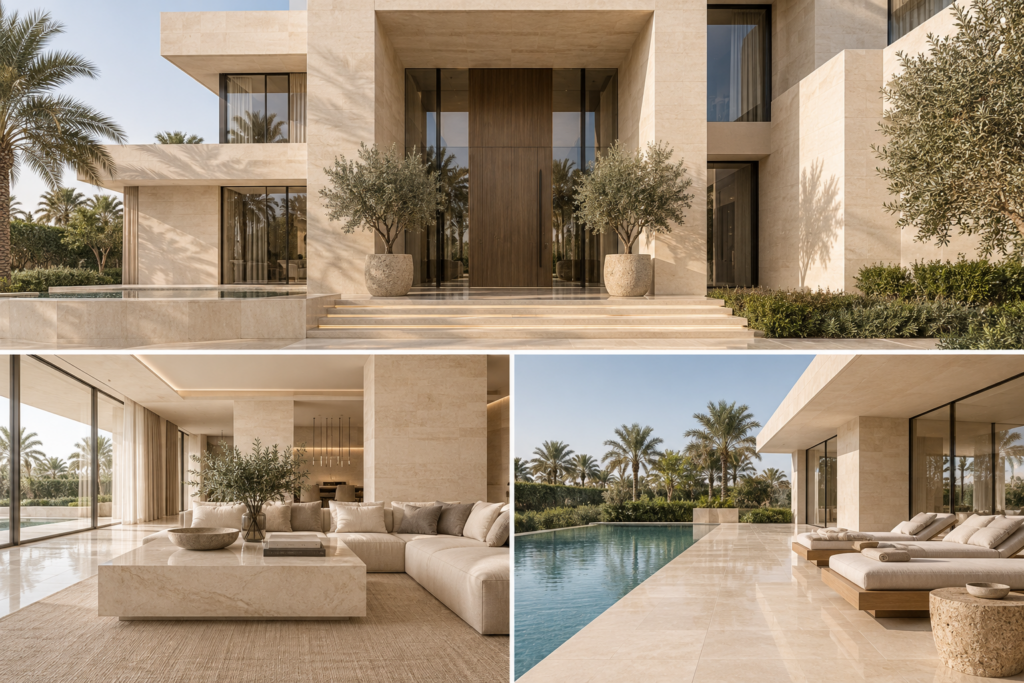
Dubai’s villa architecture is particularly suited to natural stone. Large façades, courtyards, terraces, entrances and landscape features create opportunities to use stone as an architectural material rather than simply a decorative finish. Natural stone cladding can be used on:

Villa Façades
Large-format stone can create a strong architectural exterior while maintaining a natural and understated appearance — see our marble flooring for villas.
Entrance Features
A stone-clad entrance can immediately establish the material language of a property.
Courtyards
Stone walls combined with landscaping, water and natural light can create a strong connection between architecture and the surrounding environment.
Pool Areas
Certain natural stones work well around pools and terraces, creating a softer transition between the building and landscape — see our travertine pool decks.
Boundary Walls
Stone can give boundary walls substantially more depth and character than conventional rendered finishes.
Interior Stone Cladding
Stone cladding is not limited to the exterior. Some of the most impressive applications are inside the building. A large natural stone wall can become the architectural focal point of a living room, entrance hall or reception. Common interior applications include:
- Living room feature walls
- Fireplace walls
- Reception desks
- Hotel lobbies
- Staircases
- Double-height walls
- Dining areas
- Wine rooms
- Private clubs
- Retail interiors
For these applications, the selection of the actual slab or stone pieces becomes particularly important — the natural movement should work with the architecture, lighting and surrounding materials. See our precious and semi-precious stones and onyx collections for statement interior walls.
Choosing the Right Stone for Cladding
There is no single stone that is right for every project. The correct choice depends on the architecture, application and environment. Some projects may call for a quiet limestone with subtle variation; others may require dramatic marble, textured sandstone or a more expressive natural stone. When selecting a material, we consider:
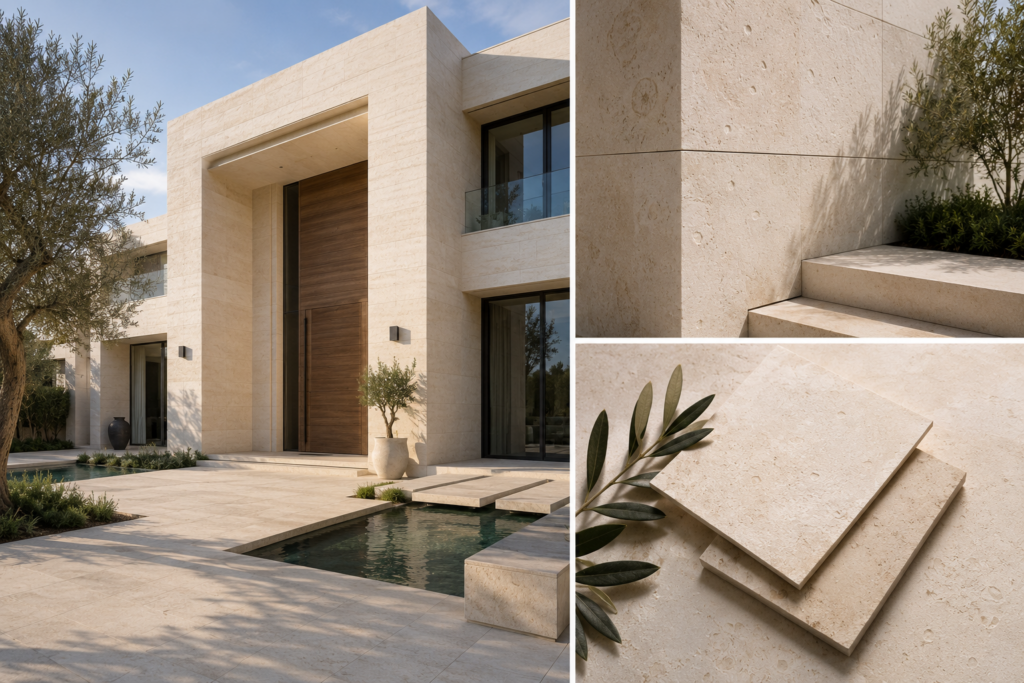
Colour — should the stone feel warm, cool, light or dark?
Texture — should the façade be smooth and refined or naturally textured?
Format — large-format pieces can create a very different architectural appearance from smaller modules.
Thickness — the required thickness depends on the application and fixing system.
Finish — honed, brushed, bush-hammered, sandblasted, split-face and other finishes can dramatically change the appearance of the same stone.
Veining and movement — for highly decorative stones, the orientation and sequencing of individual pieces can be critical.
Technical characteristics — the stone needs to be appropriate for its intended application and environmental conditions, especially for travertine wall cladding and other exterior uses.
Large-Format Stone Cladding
One of the strongest trends in contemporary luxury architecture is the use of larger stone formats. Large pieces can reduce visual interruptions and create a cleaner architectural appearance — instead of the façade reading as individual tiles, the stone can become a continuous architectural surface. This approach can be particularly effective on:
- Modern villas
- Hotel façades
- Entrance halls
- Feature walls
- Large reception spaces
- Contemporary commercial buildings
However, large-format stone requires careful planning. The project team needs to plan transportation, handling, cutting, fixing and installation before ordering the material. This is where experience matters.
Stone Cladding Is About More Than the Stone
One of the biggest misconceptions about stone cladding is that the supplier’s role is simply to provide the material. For a high-end project, there is considerably more involved.
The stone must work with the drawings, and someone needs to select the specific slab or block, calculate quantities and settle on the format. The team also has to coordinate the installation methodology and weigh the final appearance before fabrication begins.
This is why Tenetti prefers to become involved early in the project. By working with architects and designers from the design stage, we can help identify opportunities and potential issues before they become expensive problems.
From European Quarry to Dubai
Our approach is built around sourcing. Rather than limiting a project to a fixed local inventory, Tenetti can search across our European network for materials that fit the architectural brief. This can involve:
- Understanding the project — we start by understanding the architecture, application, quantities and desired aesthetic.
- Selecting potential materials — we identify suitable stones based on colour, texture, technical characteristics and availability.
- Reviewing blocks and slabs — where appropriate, we work with suppliers to identify specific blocks or slab selections.
- Coordinating logistics — we prepare the selected material for shipment to Dubai.
- Fabrication and installation coordination — we then prepare the material according to the project requirements, coordinating fabrication and installation with the wider project team.
The result is a more controlled process from European source to finished architecture.
Why Work With a Specialist Stone Supplier?
Ultra-luxury projects often involve extremely expensive finishes. A mistake in stone selection can therefore become an expensive mistake. Working with a specialist supplier gives the project team access to knowledge that extends beyond the product catalogue. At Tenetti, we work with:
- Architects
- Interior designers
- Developers
- Main contractors
- Fit-out companies
- Private clients
Our role is to provide material knowledge and sourcing expertise while working alongside the project team. We don’t believe that the most expensive stone is automatically the best choice — the right stone is the one that works with the architecture, the light and the way the space will be used.
Stone Cladding in Dubai's Climate
Dubai presents specific considerations when selecting natural stone. High temperatures, intense sunlight, dust, moisture and significant temperature changes between indoor and outdoor environments all need to be considered depending on the application.
This is why we don’t recommend selecting stone purely from a photograph. The project team needs to assess the individual material for its intended use, finish and installation system. For exterior applications in particular, the complete cladding system is important — not just the stone itself. Tenetti works with the project team to help ensure that the selected material is appropriate for the intended application.
Stone Cladding for Hotels and Hospitality
Hotels, resorts and hospitality projects can use natural stone to build a strong identity. A dramatic stone entrance, reception wall or exterior façade can become one of the defining visual elements of a property.
Natural stone is particularly effective in hospitality because designers can use it repeatedly throughout a project while it still appears different in each space, for example:
Exterior → textured limestone façade
Entrance → large-format natural stone
Reception → bookmatched feature wall
Restaurant → stone bar
Spa → softer limestone or travertine
Pool → complementary natural stone
This creates a consistent material language throughout the project.
Our Approach to Stone Cladding
At Tenetti, we don’t approach natural stone as a commodity. We believe the process should be collaborative. Our job is not simply to sell the most expensive stone available — our job is to help architects, designers and developers find the material that makes sense for their project.
Sometimes that means a rare Italian stone. Other times it means a Portuguese limestone. In other cases, it means a relatively understated material that works perfectly with the architecture. The best stone isn’t necessarily the most expensive stone — it’s the stone that is right for the architecture, the light and the way the space will be used.
European Stone. Dubai Architecture.
Tenetti began with a simple idea: making exceptional natural stone more accessible to architects, designers and developers working on high-end projects in Dubai. Our European sourcing network allows us to look beyond standard local selections and find materials with the right character, origin and technical qualities for each project.
For ultra-luxury architecture, the stone is not an afterthought — it is part of the architecture. From European quarries and suppliers to Dubai’s most ambitious villas, hotels and interiors, Tenetti helps bring that material from source to project. For large-scale commercial and hospitality developments specifically, see our dedicated page on stone cladding for commercial façades.
Looking for Stone Cladding in Dubai?
If you are working on a villa, hotel, commercial development or interior project requiring premium natural stone cladding, Tenetti can assist with sourcing, material selection and project coordination. Get in touch with our team via our contact page.
European natural stone. Carefully selected for Dubai.
Frequently Asked Questions
Everything you need to know about natural stone cladding.
Natural stone cladding is the application of natural stone panels or slabs to a building’s exterior or interior surface, such as a façade, entrance, feature wall or boundary wall. It is used both structurally as a facing system and decoratively to give architecture a sense of depth, permanence and natural variation.
There is no single best stone — the right choice depends on the application, architecture and environment. Limestone and travertine are popular for their durability and consistent tone in exterior cladding, while marble and more expressive stones are often reserved for entrances, feature walls and interior applications where their veining and character can be fully appreciated.
Large-scale exterior stone cladding is typically fixed using a ventilated (mechanically-fixed) system, where stone panels are anchored to a supporting frame with an air gap behind for drainage and thermal performance. Interior cladding and smaller applications may use adhesive fixing instead. The right system depends on building height, panel size, wind loads and the specific stone.
Yes. Natural stone cladding is used extensively both outdoors — on villa façades, entrances, boundary walls and pool areas — and indoors, on feature walls, staircases, fireplaces and reception areas. The stone, finish and fixing system are selected differently for each environment.
Properly selected and installed natural stone cladding is low-maintenance. Most stones benefit from periodic sealing, particularly for exterior applications exposed to Dubai’s sun, dust and temperature swings. The specific maintenance requirements depend on the stone type and finish chosen.
Cladding thickness varies by application and fixing system, typically ranging from around 20mm for adhered interior applications to 30mm or more for ventilated exterior façade systems. The required thickness is determined during the technical planning stage, alongside panel size and the fixing method.
Sourcing timelines depend on the material, quantity and whether a specific block or slab selection is required. Tenetti works closely with the project team from the design stage onward so that sourcing, fabrication and logistics can be planned around the project’s construction programme.
Natural stone typically carries a higher upfront cost than manufactured panels, but it offers durability, natural variation and architectural character that manufactured materials cannot fully replicate. The best value comes from selecting the right stone for the application rather than simply the most expensive option.
