Luxury Quartzite in Dubai: A Buyer’s Guide
Quartzite is a natural metamorphic stone valued for combining the dramatic veining of an exotic marble with far greater hardness and wear resistance. In Dubai’s luxury villas, hotels and commercial interiors, it has become the material of choice for architects and designers who want a natural stone that performs as well as it photographs.
Not all quartzite is the same, though. Colour, veining, origin, slab size and technical performance vary considerably from block to block. This guide explains what to look for when sourcing luxury quartzite in Dubai and how to choose the right stone for your project.
Why Quartzite Is Popular in Luxury Projects
Quartzite occupies a distinctive place in the natural stone market. It can carry the dramatic appearance associated with some of the world’s most exclusive marbles, while offering the hardness and durability that marble often lacks. For luxury projects, that combination makes it suitable for spaces where the stone needs to be both a visual statement and a hard-working surface.
Natural Beauty and Exclusivity
Every quartzite slab is different. Veining, colour variation and mineral movement form naturally over geological time. That means the actual slab a project uses carries more character than a standardised manufactured surface. For architects and interior designers, this creates an opportunity to use the stone as part of the architecture rather than simply as a finishing material.
Architects increasingly specify large quartzite slabs as a focal point in:
- Kitchen islands and countertops
- Feature walls and facades
- Reception areas and lobbies
- Bathrooms and shower walls
- Bars and staircases
- Fireplaces and bespoke furniture
Quartzite vs Marble: What Is the Difference?
Quartzite and marble are both natural stones, but they form through different geological processes and perform differently in demanding applications. Marble comes from limestone or dolomite that has undergone metamorphism. Intense heat and pressure transform quartz-rich sandstone into quartzite instead, producing a considerably harder stone.
That distinction matters when specifying stone for high-use surfaces. Quartzite can be an attractive option wherever a project needs a highly decorative natural stone combined with strong physical performance — see our marble buyer’s guide for how the two materials compare on cost and application.
The name alone should never decide the specification, though. Different stones sold commercially as “quartzite” can have different mineral compositions and technical properties, so each individual material should be assessed before it is approved for a project.
Popular Luxury Quartzite Types in Dubai
Dubai’s natural stone market gives buyers access to quartzite from several producing regions worldwide. A handful of varieties are particularly sought after for luxury residential and hospitality projects — the same materials covered in our wider guide to precious and semi-precious stones for luxury interiors.
Taj Mahal Quartzite
Taj Mahal is one of the most recognisable luxury quartzites. It typically shows a soft white, cream or warm beige background with subtle grey and gold movement, making it well suited to contemporary interiors designed around a calm, architectural atmosphere.
Taj Mahal quartzite works particularly well for kitchen islands, worktops, full-height splashbacks, bathroom vanities and large-format feature walls. Its softer palette also pairs naturally with timber, bronze, brushed metals and natural textiles.
Patrocínia Quartzite
Patrocínia quartzite is known for dramatic movement and a distinctive natural character. Depending on the block, it can display a mixture of lighter backgrounds with pronounced grey, beige and darker veining — a very different result from the quieter appearance of Taj Mahal, for projects where the stone itself is meant to be the focal point.
Blue Roma Quartzite
Blue Roma is a more expressive option, with blue, grey and white movement creating a highly distinctive appearance. It suits projects where the natural stone is meant to become an architectural feature rather than simply provide a neutral surface — feature walls, kitchen islands, bars, reception areas, bathroom walls and bespoke furniture in particular.
Emerald Quartzite
Emerald quartzite is among the most dramatic choices available to luxury projects. Its deep green tones and natural movement create a strong visual statement when used selectively — around entrances, bars, powder rooms, islands and feature walls in a villa or hospitality project. As with our dramatic onyx options, the exact appearance can vary significantly between blocks, so slab selection matters.
What to Consider When Choosing Quartzite in Dubai
Selecting quartzite should involve more than choosing the most attractive slab. The stone needs to work with the architecture, the lighting, the application and the practical requirements of the project.
Durability and Application
Quartzite is often selected for demanding applications because of its hardness and resistance to wear, but technical performance still varies between materials. Before specifying a stone, consider its hardness, water absorption, porosity, stain resistance, thickness, finish, intended application, edge details and maintenance requirements.
A quartzite suitable for a kitchen worktop may also work well in other demanding interior applications, but we always assess the specific stone’s technical properties before approval — the same standard the Natural Stone Institute recommends.
Colour and Lighting
Dubai’s strong natural light can significantly change how a stone appears. A slab that looks relatively neutral under showroom lighting may read warmer, cooler or more dramatic once installed in a villa with large windows and strong daylight. This effect is especially strong with quartzite, since its natural mineral movement reacts to changing light. For major projects, we recommend viewing the actual slabs in person wherever possible rather than relying solely on photographs or small samples.
Slab Size and Continuity
Slab dimensions have a major impact on the final design. Large-format quartzite helps create uninterrupted surfaces and reduces visible joints, which matters most for kitchen islands, feature walls and bookmatched installations.
Before ordering, architects and contractors should plan the essentials: slab dimensions, thickness, number of slabs, vein direction, bookmatching and cutting layout. Waste allowance and installation access matter too, especially for bookmatched pairs. A beautiful stone can lose some of its impact if the slab layout wasn’t considered at the design stage.
Bookmatched Quartzite
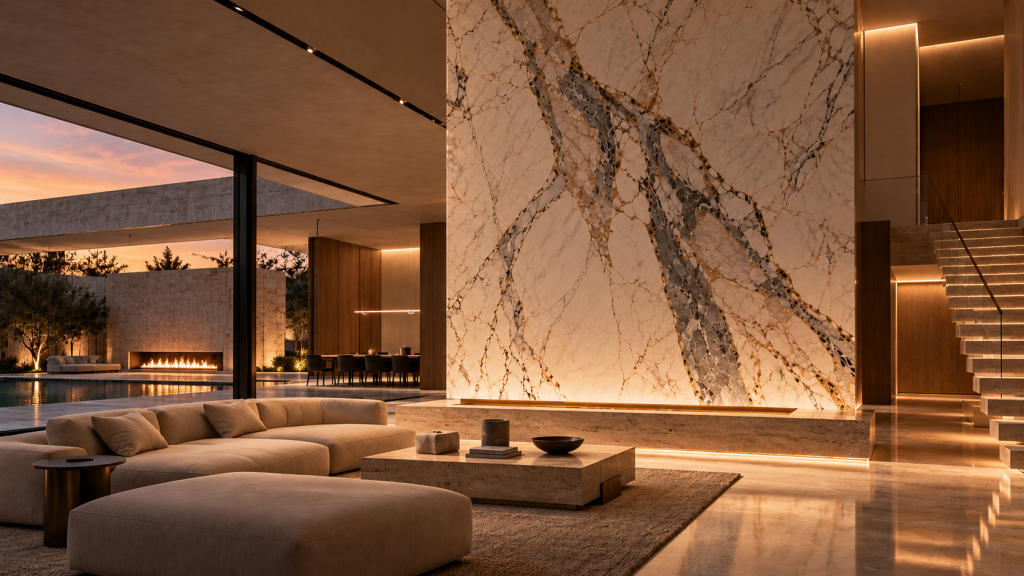
Bookmatching is one of the most effective ways to showcase highly veined quartzite. Placing two slabs side by side lets their natural patterns mirror each other — when the block has strong movement, the result can resemble a natural piece of artwork.
Bookmatched quartzite is particularly effective for feature walls, fireplace surrounds, large kitchen islands, hotel reception areas, entrance halls and statement bathrooms. It requires planning from the start of a project: the block, slab sequence, cutting plan and installation all need coordinating to achieve the intended result.
Finishes: Polished, Honed and Textured
The finish changes both the appearance and the practical characteristics of quartzite.
Polished Quartzite
A polished finish brings out colour, depth and natural movement. It works well when the objective is to highlight the stone’s veining and create a refined, reflective surface.
Honed Quartzite
A honed finish creates a softer, more understated appearance. It reduces surface reflection and suits contemporary interiors where the stone needs to feel architectural rather than highly glossy.
Leathered and Textured Finishes
Depending on the specific stone, textured finishes can add tactile character and emphasise the natural structure of the material. The right finish ultimately depends on the stone, the application and the overall design concept.
Why Sourcing Matters
The quality of quartzite begins long before the slab reaches Dubai. Natural stone varies considerably from block to block, and two slabs carrying the same commercial name can have noticeably different colours, patterns and movement. For high-end projects, sourcing becomes part of the design process itself.
Working with an experienced natural stone supplier gives architects and developers access to international quarry networks, larger blocks, carefully selected slabs, project-specific sourcing, material samples, slab selection, fabrication and installation coordination.
At Tenetti, we work across our European sourcing and production network to select natural stone for projects in Dubai and beyond. Our approach isn’t to find the most expensive material — it’s to find the stone that’s right for the architecture, the light, the application and the way the space will be used.
Luxury Quartzite for Dubai Villas
Quartzite can be particularly effective in luxury villas where the same material needs to work across several spaces. A project might use a quieter quartzite like Taj Mahal for a large kitchen island while introducing a more dramatic stone, such as Emerald or Blue Roma, in a powder room, bar or feature wall — creating consistency without making every room identical.
In Dubai villas, we commonly specify quartzite for kitchen countertops and islands, bathroom vanities and shower walls, feature walls, staircases, fireplaces, bars, furniture and entrance areas — many of the same spaces covered in our guide to marble flooring for luxury villas. The best result usually comes from using the stone selectively rather than covering every available surface.
Quartzite for Architects and Interior Designers
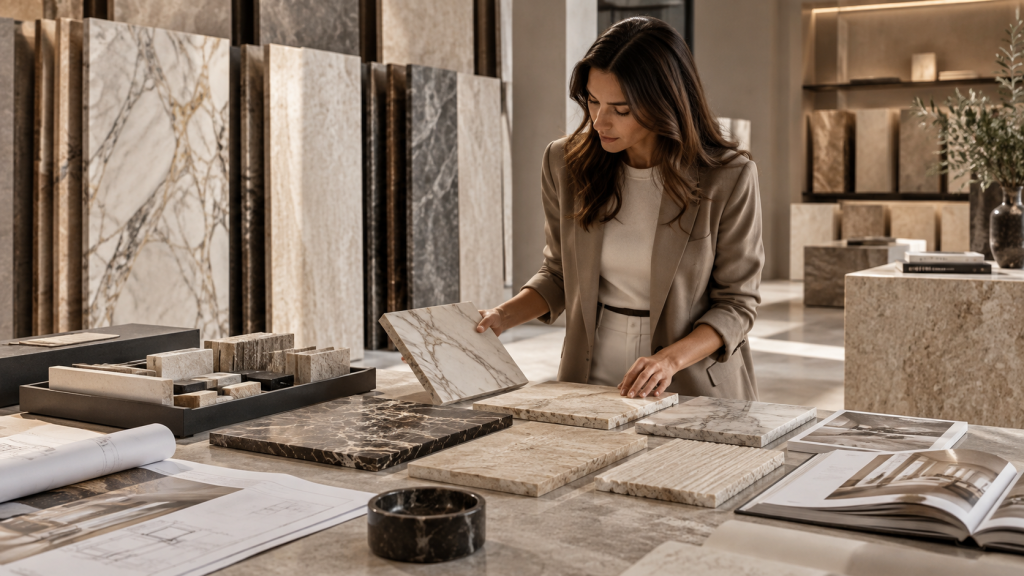
For architects and designers, selecting quartzite is often as much about material planning as aesthetics. Architects should weigh the stone alongside the drawings, dimensions, lighting and joinery from an early stage, rather than add it as a finishing decision at the end of the process.
At Tenetti, we work closely with architects, interior designers and developers on stone selection, slab sourcing, samples, quantity planning, vein matching, bookmatching, fabrication and installation — the same collaborative process behind our work on hospitality and hotel projects across the UAE.
Is Quartzite Worth Considering for a Luxury Project?
There’s no single “best” natural stone for every project. Marble, quartzite, limestone, travertine and other natural materials each have different characteristics. Quartzite is particularly interesting when a project needs a combination of strong visual character and demanding practical performance.
The most expensive stone isn’t necessarily the right stone. The right stone is the one that works with the architecture, the light and the way the space will be used.
Conclusion
Luxury quartzite has become an increasingly popular material for Dubai’s high-end residential, hospitality and commercial projects. Its natural variation gives every slab individual character, while many quartzites offer the hardness and durability that demanding applications require.
From understated Taj Mahal to dramatic Emerald and Blue Roma, the range of colours and geological patterns lets architects and designers create spaces that feel individual rather than manufactured. Selecting the right one takes more than choosing a colour from a catalogue — the quarry, block, slab, application, finish, lighting and installation all shape the final result.
Frequently Asked Questions
Intense heat and pressure transform quartz-rich sandstone into quartzite, a natural metamorphic rock known for its hardness and distinctive natural veining.
Quartzite and marble have different characteristics, so the right choice depends on the application and design goals. Quartzite is generally harder and more wear-resistant, while marble offers its own distinctive range of colours and veining.
Many quartzites suit kitchen countertops and islands, particularly where durability matters. We still assess the specific stone’s technical properties before specification.
Taj Mahal quartzite is one of the most recognisable luxury quartzites, particularly for projects seeking a light, warm and relatively understated appearance. Patrocínia, Blue Roma and Emerald offer more dramatic movement and colour.
Prices vary considerably by quarry, block quality, slab size, thickness, finish and availability. Rare or highly decorative quartzites can command significantly higher prices than more readily available materials, so we recommend a project-specific quote rather than a general price per square metre.
Tenetti sources premium natural stone, including Taj Mahal, Patrocínia, Blue Roma and Emerald quartzite, for luxury villas, hospitality and commercial projects across Dubai and the wider UAE.
Yes. Bookmatching works particularly well with quartzite that has strong natural movement. Fabricators select and sequence the slabs together from the same block to achieve the intended visual continuity.
Suitability depends on the specific quartzite, its technical properties, finish and intended application. Buyers should weigh Dubai’s heat, UV exposure and environmental conditions when selecting natural stone for exterior use.
Discover Luxury Quartzite with Tenetti
We believe selecting natural stone should be a collaborative process. From the first sample through to slab selection, fabrication and installation, our role is to help find the stone that makes sense for your project — because the right stone is the one that belongs in the architecture.
Planning a villa, hotel or commercial project in Dubai? Talk to Tenetti about sourcing luxury quartzite for your next project.