
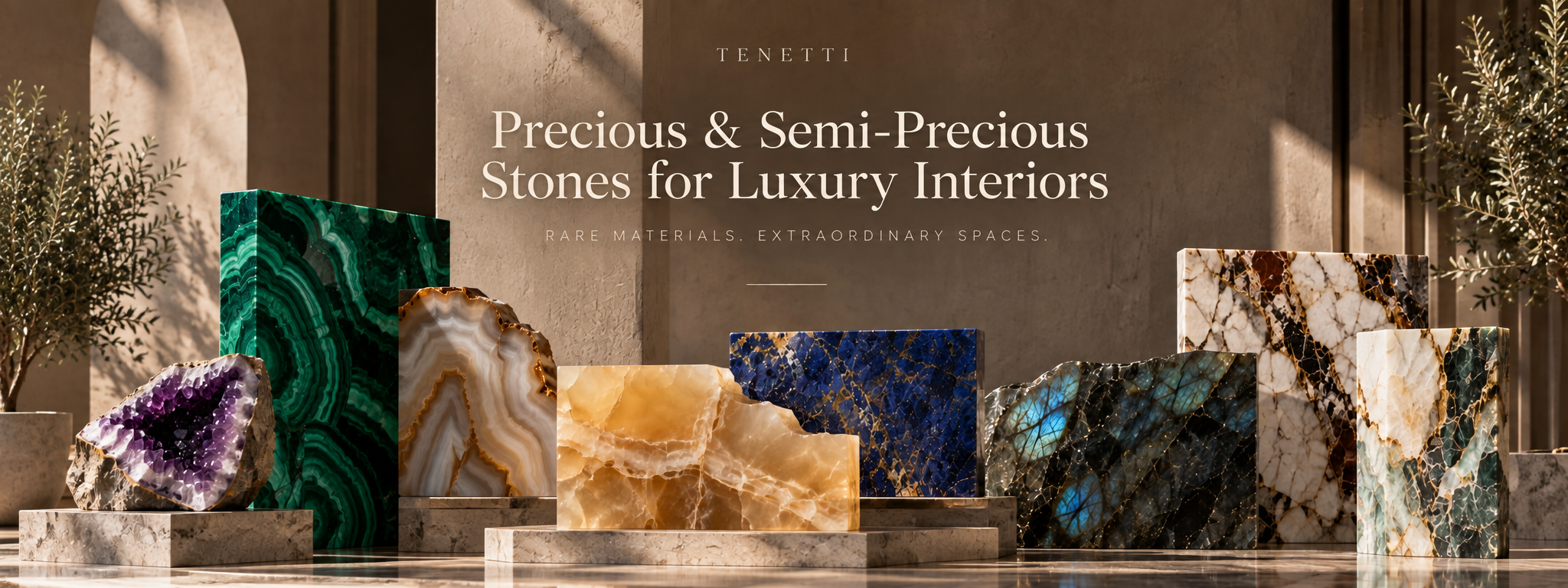
The most exceptional interiors are rarely defined by ordinary materials. In ultra-luxury residential, hospitality and commercial projects, precious and semi-precious stones can become more than a surface: they can be the centrepiece of an interior.
In fact, precious and semi-precious stones such as malachite, agate, onyx, lapis lazuli, amethyst and labradorite offer colours, patterns, translucency and natural formations that are impossible to reproduce consistently with manufactured materials. Used carefully, they can transform walls, furniture, bars, bathrooms, entrances and other architectural features into one-of-a-kind elements.
At Tenetti, we have extensive experience working with architects, interior designers and private clients on luxury projects in Dubai and across the UAE, where the selection of the actual stone is as important as the material itself. For exceptional interiors, it is often not enough to specify “ontyx” or “malachite”, the individual slab, block, pattern, colour and translucency can determine the final result.
Ready to explore rare stone for your project?
Start Your ProjectWhat Are Precious and Semi-Precious Stones?
The terms precious stone and semi-precious stone are widely used in the luxury interiors and decorative-stone industry, although, according to gemology, they do not represent a strict scientific classification.
In traditional gemology, the principal precious gemstones are generally considered to be diamond, ruby, sapphire and emerald. However, many other minerals and stones used in luxury interiors are commonly described commercially as semi-precious.
For architecture and interior design, the more useful distinction is between ordinary building stone and rare decorative materials whose beauty, scarcity, natural patterning or translucency makes them suitable for highly exclusive applications.
These materials can include:
- Malachite
- Agate
- Onyx
- Lapis lazuli
- Amethyst
- Labradorite
- Rare quartzites
- Exotic marble
- Other rare and decorative natural stones
In fact, their value is determined by much more than the name of the material. Colour, pattern, rarity, origin, block quality, slab size, translucency, consistency and availability can all have a significant impact.
Why Are These Materials Used in Ultra-Luxury Interiors?
Rare natural stones offer something that is difficult to achieve with conventional materials: individuality.
Indeed, no two natural blocks are exactly alike. Even slabs from the same block can display different movements, colours and patterns.
For architects and interior designers, this creates opportunities to design around the natural characteristics of the material rather than simply placing a standard surface into a room.
In particular, some of the characteristics that make these stones particularly desirable include:
Natural patterning
Materials such as malachite and agate can contain extraordinary natural patterns that become part of the architectural design.
Translucency
Onyx and agate can allow light to pass through the stone, creating dramatic effects when illuminated from behind.
Rarity
Some colours, formations and blocks are extremely difficult to source consistently, making them appropriate for projects where exclusivity is important.
Individuality
The actual slab or block selected determines the final surface. This makes every completed installation unique.
Craftsmanship
Rare stone becomes even more impressive when combined with expert cutting, polishing, bookmatching, edge detailing and installation.
The Most Sought-After Precious and Semi-Precious Stones for Luxury Interiors
Malachite
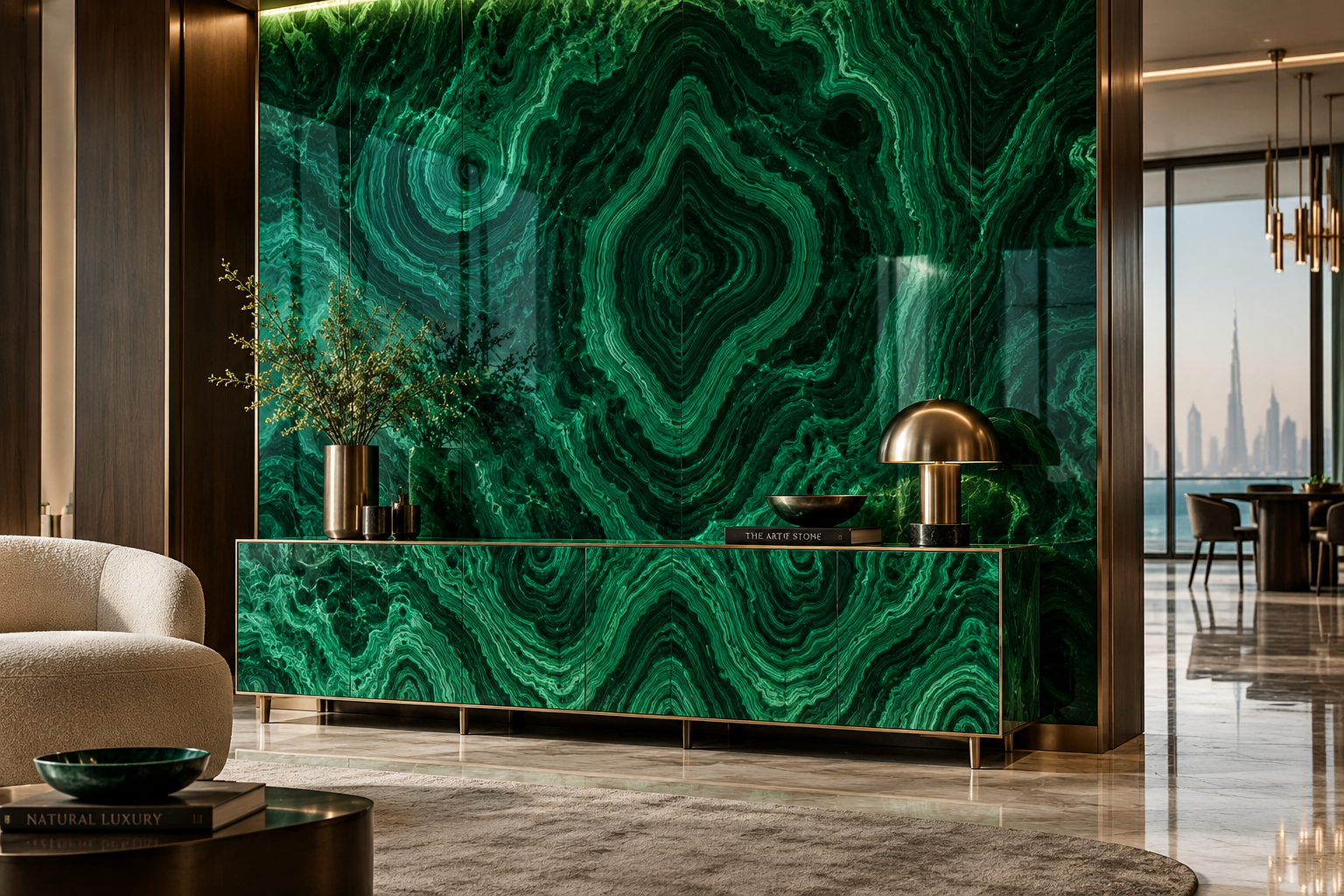
In particular, malachite is immediately recognisable for its intense green colour and distinctive concentric banding.
As a result, its dramatic appearance makes it particularly effective when the stone is treated as a feature rather than a background material.
Why is malachite luxurious?
Indeed, the appeal of malachite comes from its strong natural patterning and rich green colour. High-quality material can display remarkable variations in tone and movement.
Interior applications
Malachite works well for:
- Feature walls
- Decorative panels
- Bars
- Reception areas
- Cabinetry and furniture
- Tables
- Small architectural details
As such, because of its visual intensity, malachite is often most effective when used selectively.
Agate
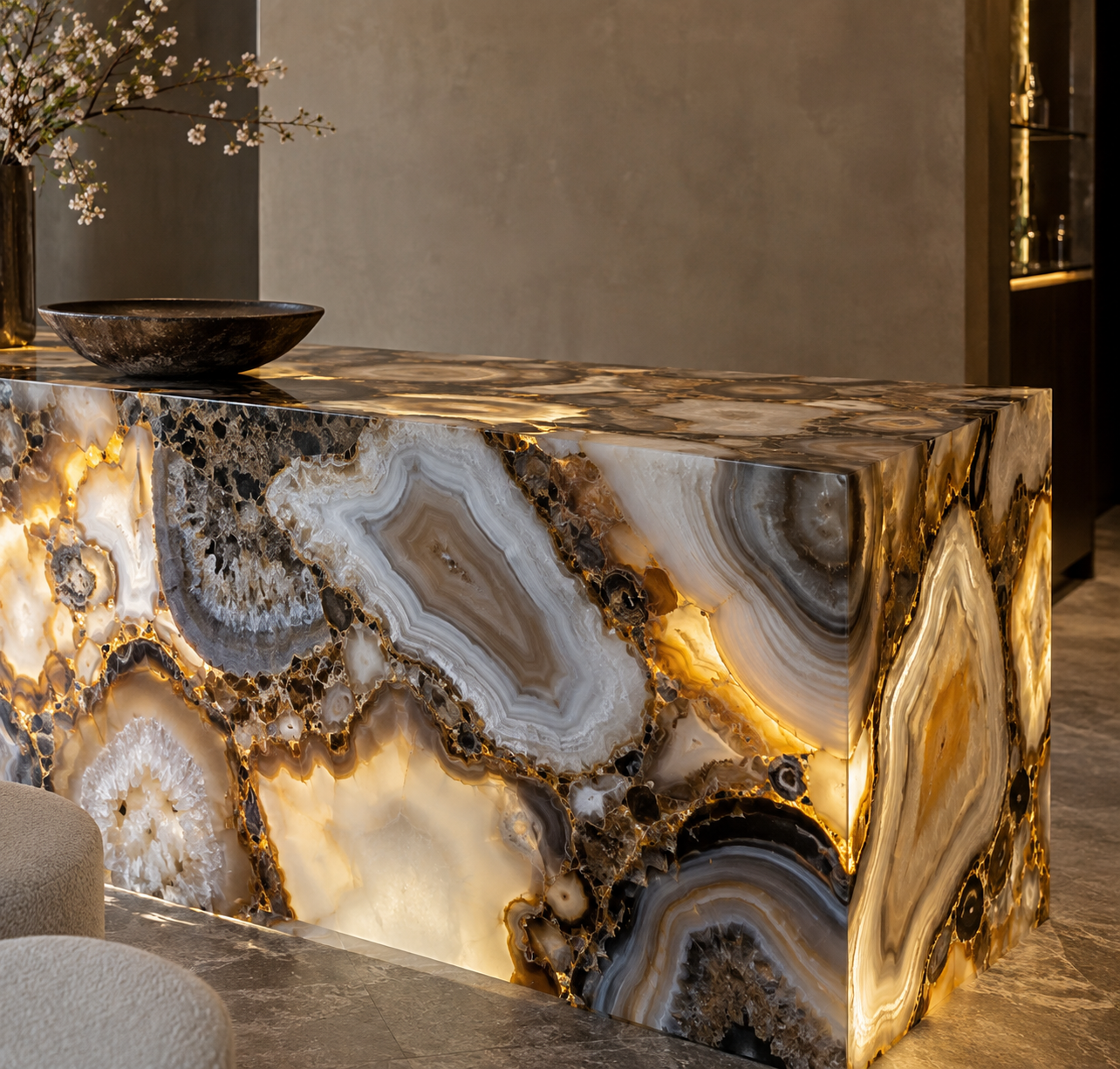
For instance, agate is one of the most spectacular materials for decorative interiors, particularly when it is backlit.
As a result, its naturally translucent structure can reveal layers, bands and variations in colour when illuminated from behind.
Why is agate luxurious?
For example, every section can reveal a different geological formation. With the right lighting, the stone can appear almost luminous.
Interior applications
Agate is particularly suited to:
- Feature walls
- Bar fronts
- Reception desks
- Decorative panels
- Furniture
- Backlit architectural installations
- Statement pieces
In such cases, the lighting design is often just as important as the stone itself.
Onyx
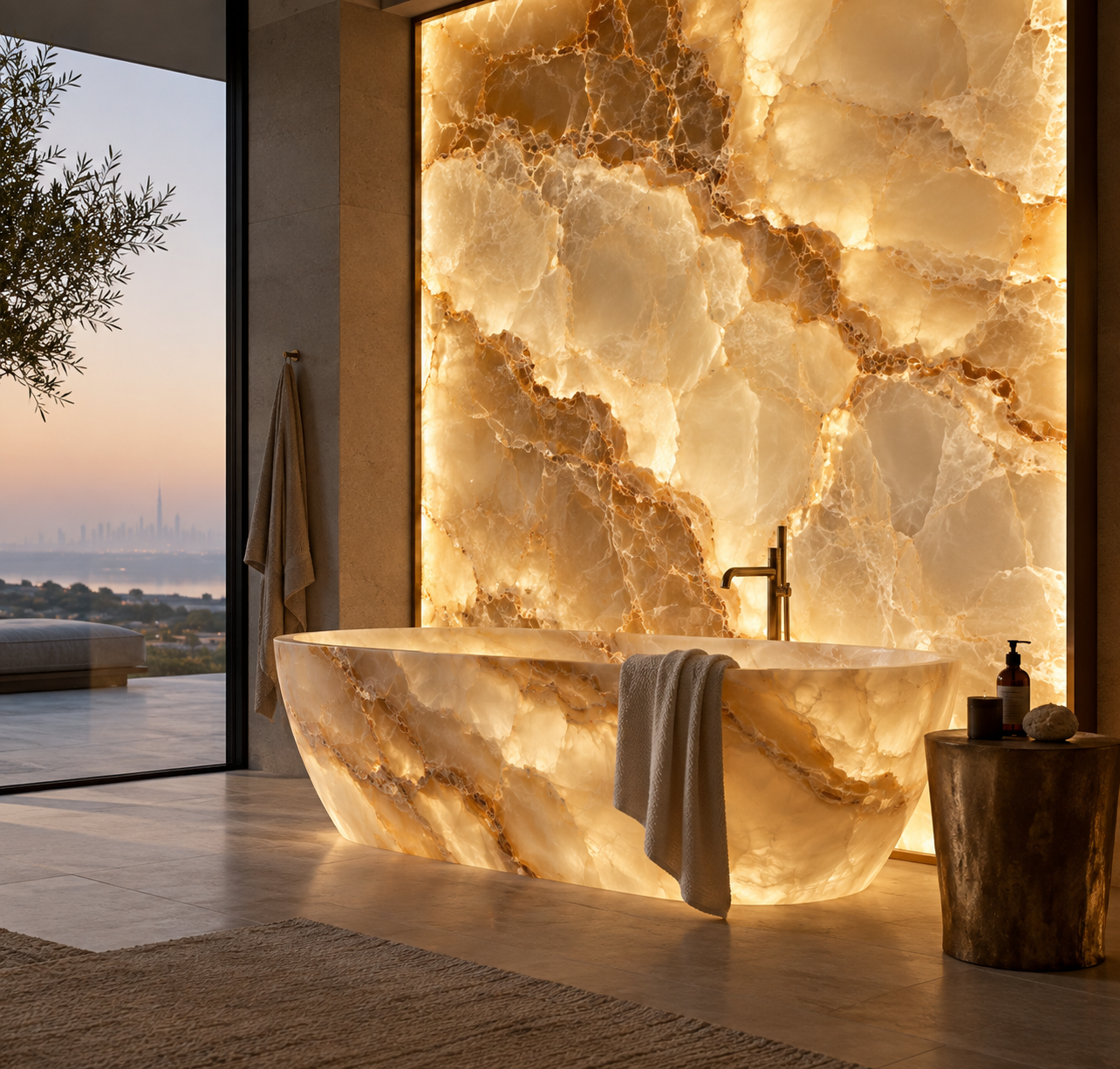
For example, onyx is one of the best-known luxury decorative stones and is particularly valued for its translucency and colour variation.
It can range from white and cream through honey, yellow, green, pink and red tones.
Why is onyx luxurious?
As a result, its ability to transmit light creates possibilities that conventional marble and stone cannot easily reproduce.
As a result, a carefully selected onyx slab can become an illuminated architectural feature, with its natural layers becoming visible when lit from behind.
Interior applications
Common applications include:
- Feature walls
- Bathrooms
- Bars
- Reception areas
- Vanity surfaces
- Decorative partitions
- Furniture
- Backlit panels
However, the quality of the individual slab is critical. Two pieces of onyx can have dramatically different visual characteristics. Explore this in more depth in our guide to backlit onyx, see real examples in our onyx for luxury villas feature, or browse our full onyx collection.
Lapis Lazuli
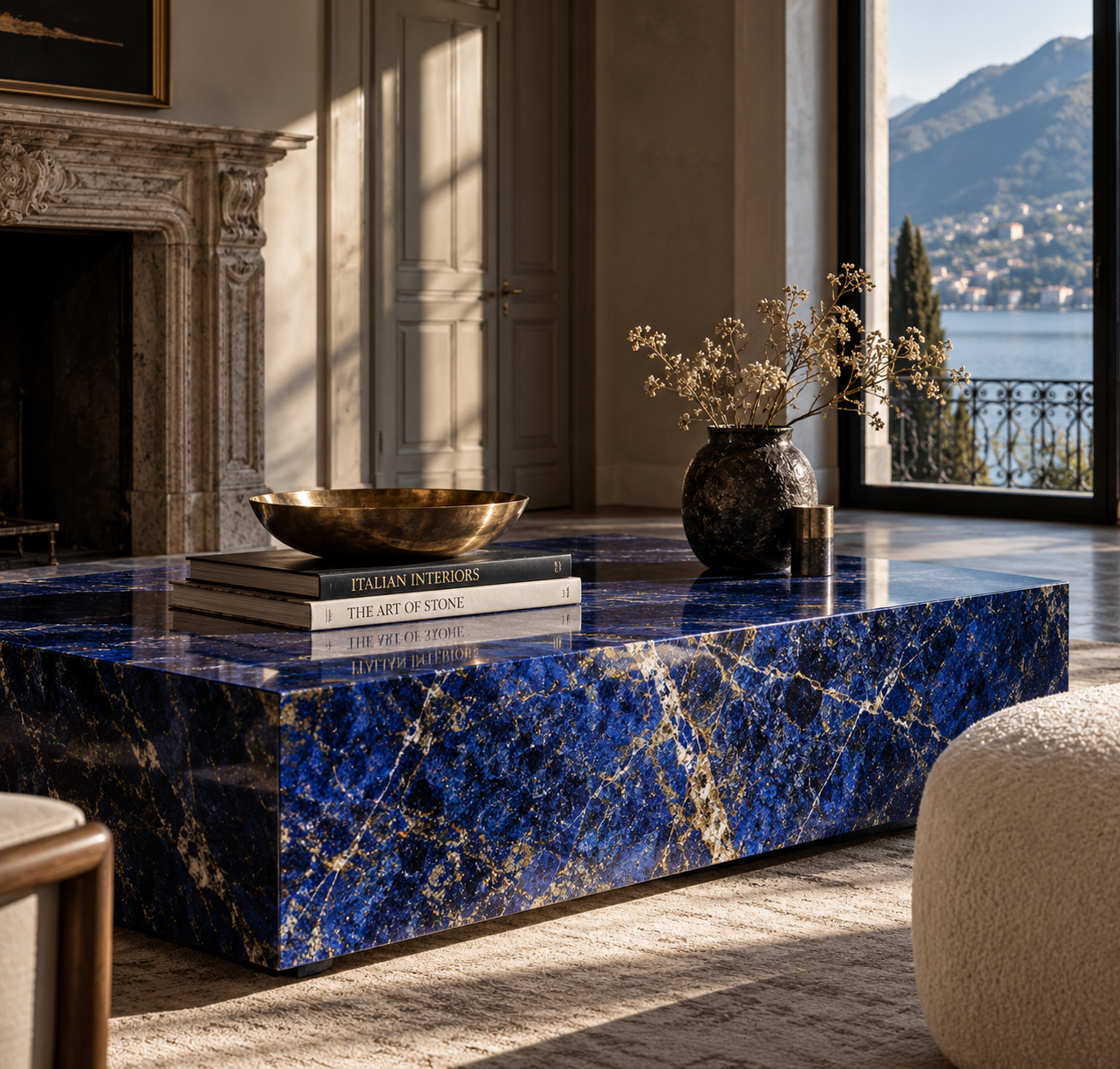
Notably, lapis lazuli is famous for its intense blue colour, often accompanied by natural golden pyrite inclusions.
Historically, it has been prized for centuries as a decorative material and remains highly distinctive in contemporary luxury interiors.
Why is lapis lazuli luxurious?
As a result, the combination of deep blue colour and naturally occurring golden details gives the material an appearance that can resemble a piece of artwork.
Interior applications
Lapis lazuli suits:
- Feature surfaces
- Decorative panels
- Furniture
- Tables
- Wall details
- Bespoke interior elements
As such, it is particularly suited to projects where a strong colour statement is desired.
Amethyst
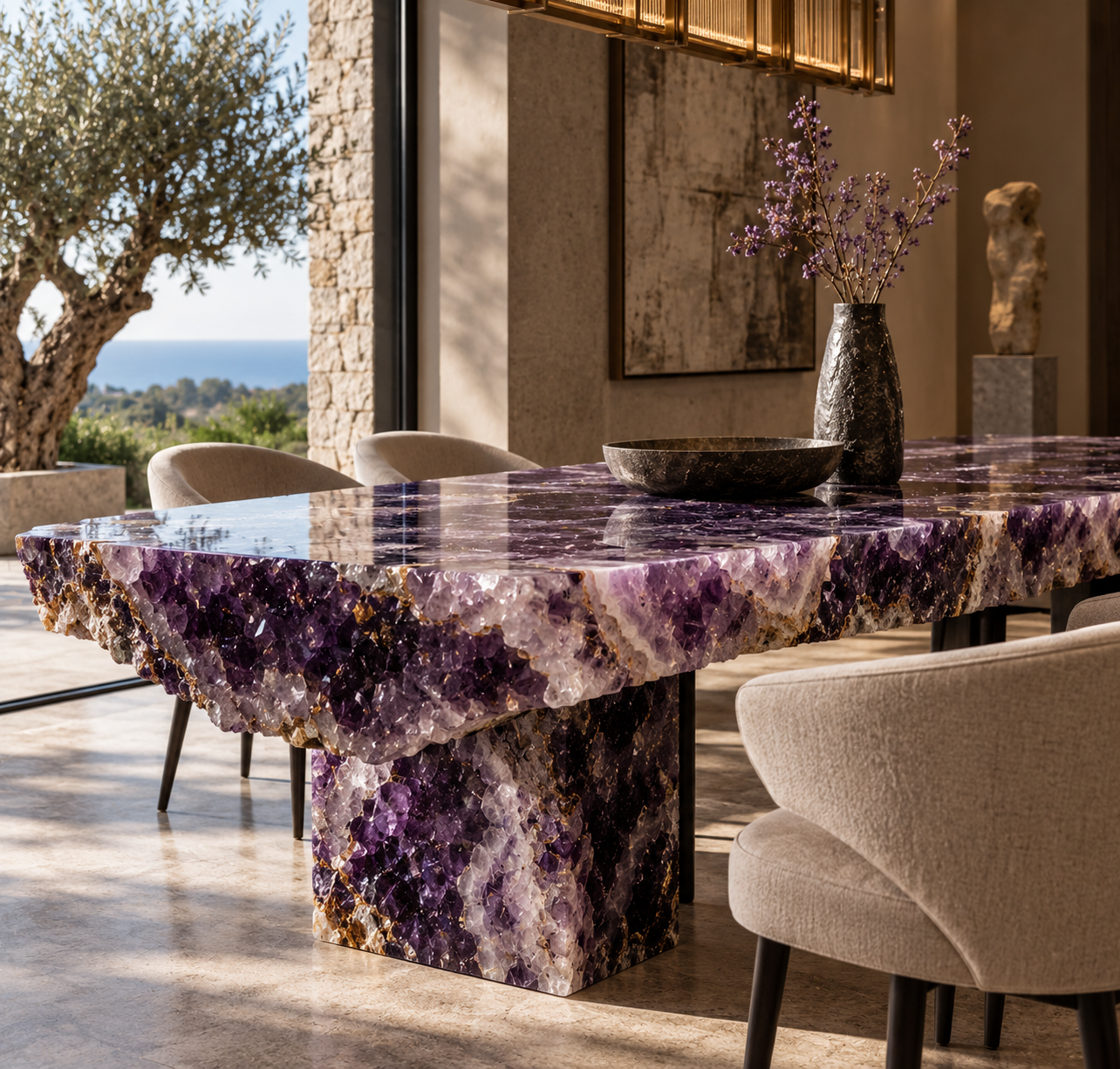
Notably, amethyst is a purple variety of quartz known for its crystalline structure and distinctive violet colour.
In interiors, it is generally used as a decorative and artistic material rather than as a conventional architectural surface.
Why is amethyst luxurious?
In particular, large and visually impressive formations can create a striking natural focal point. The crystalline structure gives the material depth and character that cannot be replicated by ordinary finishes.
Interior applications
Amethyst suits:
- Decorative installations
- Furniture
- Sculptural features
- Bespoke tables
- Feature elements
- Luxury hospitality interiors
Labradorite
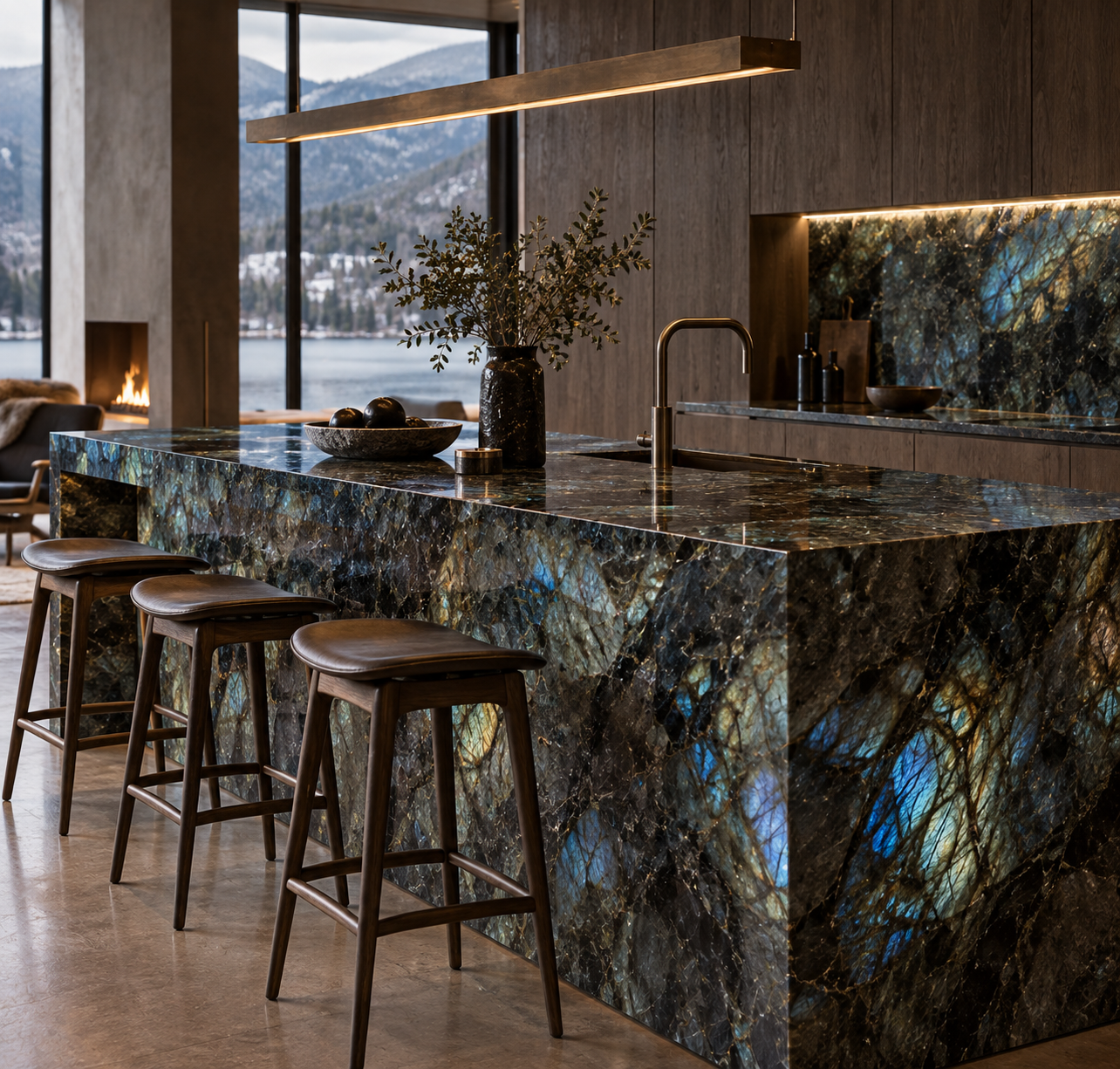
In particular, labradorite is known for its remarkable iridescence, often displaying flashes of blue, green, gold and other colours as the surface catches the light.
Why is labradorite luxurious?
As a result, its appearance can change depending on viewing angle and lighting conditions, giving large surfaces a dynamic quality.
Interior applications
Labradorite suits:
- Kitchen islands
- Feature walls
- Bars
- Reception areas
- Vanity surfaces
- Furniture
- Bespoke architectural elements
As a result, a carefully selected labradorite slab can become a natural focal point in a dramatic contemporary interior.
Quartzite
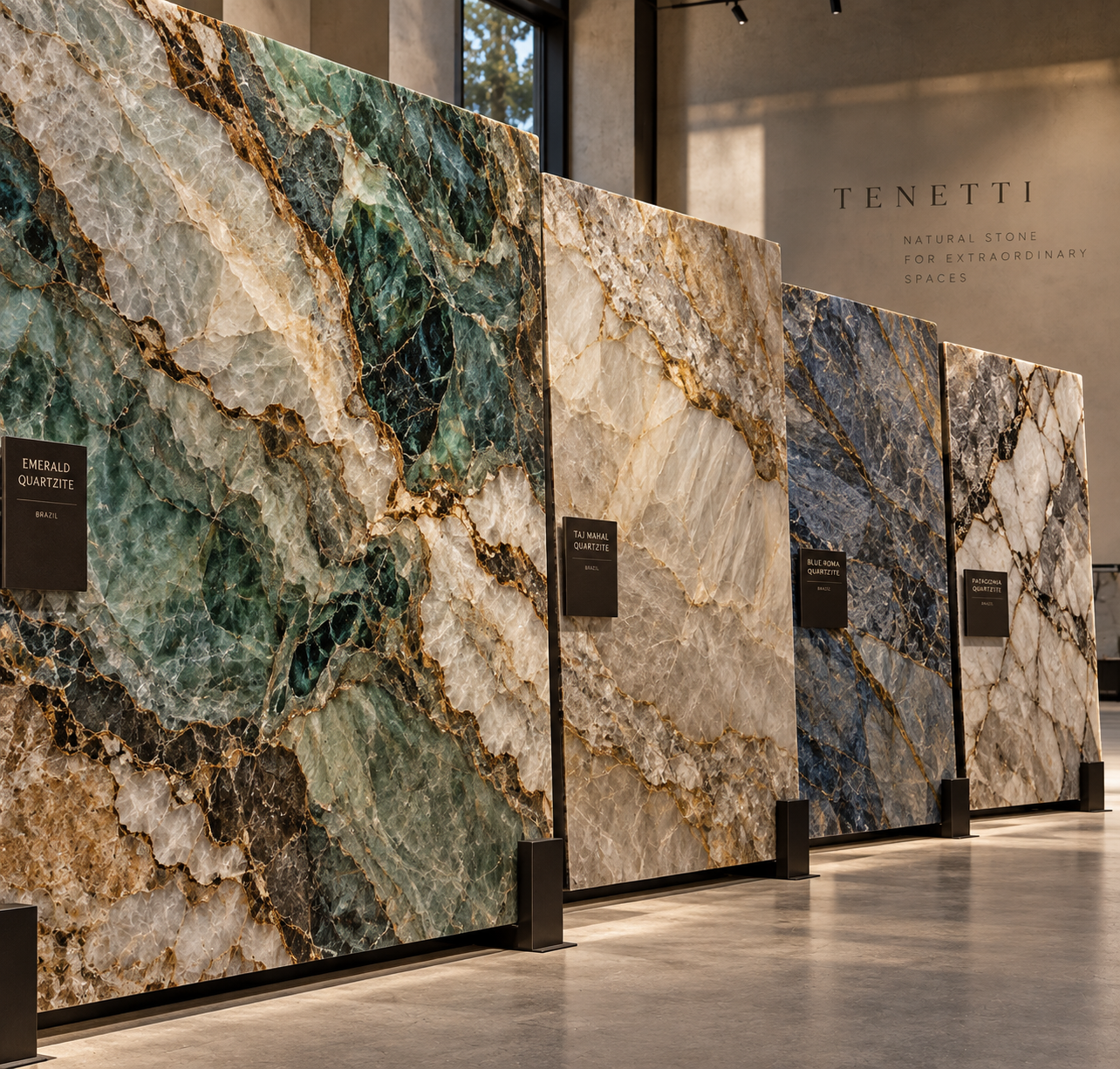
Quartzite is not generally classified as a precious or semi-precious stone, but rare and highly decorative quartzites occupy an important position in the ultra-luxury natural-stone market.
Certain quartzites display extraordinary colours, veining and geological formations. Emerald Quartzite and Blue Roma Quartzite show a colour intensity rarely seen outside precious stones, while varieties such as Taj Mahal and Patrocínia Quartzite are valued for their soft, luminous background tones combined with dramatic natural veining.
Why is quartzite luxurious?
As a result, the combination of dramatic aesthetics and strong physical performance makes premium quartzite particularly attractive for demanding architectural applications.
Interior applications
Quartzite suits:
- Kitchen islands
- Worktops
- Bathrooms
- Feature walls
- Flooring
- Staircases
- Large architectural surfaces
In short, rare quartzites can provide the visual drama of exotic stone while offering properties that make them suitable for more functional applications.
For a closer look at Taj Mahal, Patrocínia, Blue Roma and Emerald quartzite — including pricing, finishes and where to buy them in Dubai — see our luxury quartzite buyer’s guide.
Exotic Marble
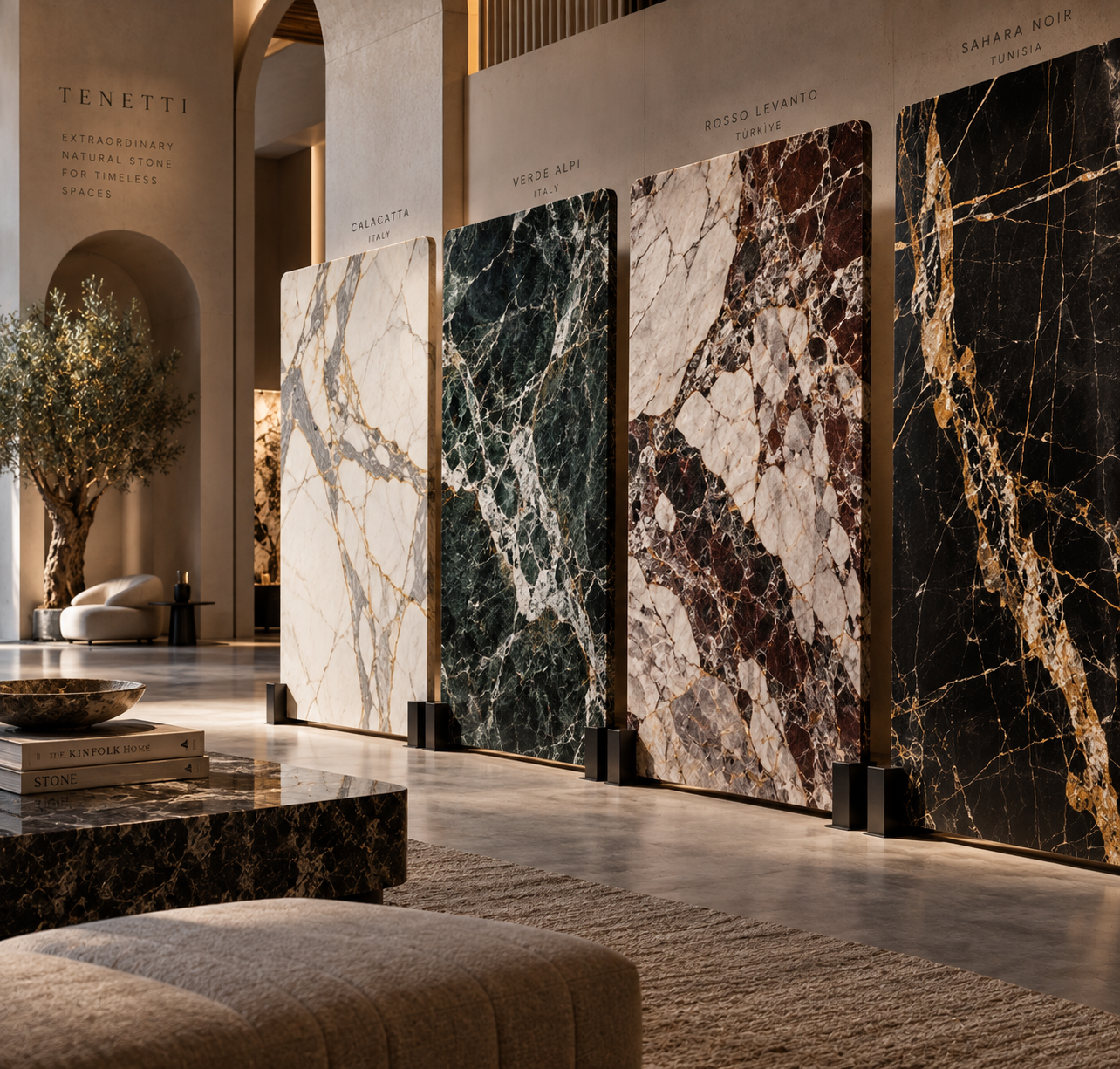
Marble is not normally described as a precious or semi-precious stone, but rare exotic marbles belong in the same conversation when discussing ultra-luxury interiors.
Certain marbles are exceptionally rare, with unusual colours, dramatic veining or distinctive geological formations. Varieties such as Sahara Noir, with its dense black background and gold veining, or Verde Alpi, prized for its deep green tone and dramatic white movement, are typical of the rarity this category represents.
Why is exotic marble luxurious?
In particular, the value can come from scarcity, appearance, provenance, block quality and the ability to obtain large, visually consistent slabs. A slab of Sahara Noir or Rosso Levanto, for example, can vary considerably in pattern and intensity from block to block, which is exactly what makes each one so distinctive.
As a result, for a luxury project, the difference between an ordinary marble and an exceptional block can be substantial.
Interior applications
Exotic marble works well for:
- Floors
- Walls
- Staircases
- Fireplaces
- Bathrooms
- Kitchens
- Feature installations
- Bespoke furniture
For more on selecting exotic marble for a luxury project, see our buyer’s guide to luxury marble in Dubai, or browse our marble collection.
Comparing Luxury Decorative Stones
| Material | What makes it luxurious | Typical interior applications |
|---|---|---|
| Malachite | Rich green colour and distinctive natural banding | Walls, furniture, bars |
| Agate | Translucency and spectacular natural layers | Feature walls, panels, bars |
| Onyx | Translucency, colour and natural movement | Walls, bathrooms, bars |
| Lapis Lazuli | Deep blue colour with natural pyrite | Feature surfaces, furniture |
| Amethyst | Dramatic crystalline formations | Decorative installations, furniture |
| Labradorite | Iridescent flashes of colour | Islands, walls, bars |
| Quartzite | Exceptional patterns and strong performance | Kitchens, bathrooms, walls |
| Exotic Marble | Rare colours and dramatic veining | Floors, walls, staircases |
Selecting the Right Precious and Semi-Precious Stones for an Ultra-Luxury Project
Therefore, with rare materials, selecting the stone should happen before the design is finalised, rather than treating the material as an interchangeable finish.
As a result, the individual block or slab can determine the direction of the design.
1. Start with the architecture
For example, the stone should complement the proportions, lighting and architectural language of the space.
A highly patterned malachite or agate may work beautifully as a focal element but become overwhelming if used everywhere.
2. Review the actual slabs
In such cases, images of a material are rarely enough.
Review the actual slabs for:
- Colour
- Veining
- Pattern
- Thickness
- Dimensions
- Surface quality
- Natural variation
Our guide for architects and interior designers.
3. Consider bookmatching
For instance, mirroring adjoining slabs where appropriate creates a continuous or symmetrical pattern.
In particular, bookmatched stone can be particularly effective with strongly veined marble, agate, onyx and other decorative materials.
4. Consider lighting
For example, translucent materials such as onyx and agate can change dramatically when backlit.
Therefore, plan the stone selection and lighting design together.
5. Understand the application
However, not every decorative stone is suitable for every application.
A beautiful material may be better suited to a wall or decorative panel than a heavily used kitchen worktop. Assess technical characteristics, fabrication requirements and maintenance before specification.
Sourcing Rare Precious and Semi-Precious Stones for Luxury Architecture
For ultra-luxury projects, sourcing is part of the design process.
Instead, the challenge is often not finding a material with a particular name, but finding the right block or slabs with the right combination of colour, movement, dimensions and quality.
As a result, this is where specialist stone sourcing becomes particularly valuable.
For this reason, at Tenetti, we work closely with architects, interior designers and clients on luxury projects to identify, source and select exceptional natural materials. Our experience extends beyond standard commercial stone selection: for highly bespoke projects, we can help assess individual slabs and blocks, understand how they will work within the architectural design, and coordinate the material through the project.
Indeed, for an ultra-luxury interior, the objective is not simply to specify “green onyx”, “malachite” or “exotic marble.”
Instead, the objective is to find the specific material that makes the project exceptional. Explore our full range of natural stone products to see what’s available for your next project.
Precious Stone as Architecture
In short, the most successful use of rare natural stone is often not about covering the largest possible surface area.
Instead, it is about creating a moment.
- A backlit onyx wall behind a bar.
- A bookmatched exotic marble entrance.
- A malachite feature integrated into bespoke furniture.
- A rare quartzite kitchen island selected around its natural movement.
- An agate panel used as the centrepiece of a reception.
As a result, these applications allow the geology of the stone to become part of the architecture.
In short, for architects and designers working at the highest end of the market, that individuality is often precisely what makes natural stone worth specifying.
Frequently Asked Questions
Some of the most sought-after materials include malachite, agate, onyx, lapis lazuli, amethyst, labradorite, rare quartzites and exotic marble. The most luxurious material depends on its rarity, colour, pattern, quality, dimensions and availability rather than simply its name.
Malachite is generally described commercially as a semi-precious stone rather than one of the traditional precious gemstones. In luxury interiors, it is valued for its intense green colour and distinctive natural banding.
Onyx used in architecture is generally considered a decorative natural stone rather than one of the traditional precious gemstones. It is particularly valuable in luxury interiors because of its translucency, colour and ability to be backlit.
There is no single best material. Onyx and agate are particularly effective when backlighting is desired, while malachite, exotic marble and labradorite can create dramatic visual statements without relying on translucency.
Yes. Onyx and many varieties of agate are particularly well suited to backlighting because of their translucency. The exact result depends on the individual stone, thickness, fabrication and lighting system.
Yes. They can be exceptionally effective in luxury villas when used selectively for feature walls, bars, bathrooms, furniture, entrance areas and other focal points.
More Frequently Asked Questions
Some can, but suitability depends on the specific material and application. Quartzite, for example, can be well suited to demanding surfaces, while more delicate decorative stones may be better used for walls, furniture or other lower-impact applications. Technical properties should always be assessed before specification.
Natural stone varies from slab to slab. Colour, veining, pattern, inclusions and movement can all change. For an ultra-luxury project, reviewing and selecting the actual slabs can therefore be critical to achieving the intended design.
Yes. Tenetti works with architects, interior designers and clients on luxury projects requiring rare and highly decorative natural materials. With extensive experience in stone sourcing and project coordination, Tenetti can assist with identifying suitable materials, reviewing individual slabs and blocks, and finding exceptional stone for bespoke architectural applications.
Yes. Tenetti works closely with architects and interior designers from the material-selection stage through sourcing and project coordination. For particularly exclusive projects, the process can involve reviewing individual slabs, considering bookmatching and pattern continuity, assessing technical suitability and sourcing material that fits the architectural concept.
Working with Tenetti
Rare natural stone can be incorporated throughout a luxury interior, including feature walls, entrances, staircases, bathrooms, kitchens, bars, reception areas, fireplaces, furniture, tables and decorative installations. The ideal application depends on the technical properties and visual characteristics of the individual material.
Rarity can come from several factors: limited quarry availability, unusual colour, distinctive geological formation, exceptional veining, scarcity of large blocks, consistent patterning or difficulty sourcing material of sufficient quality and size.
At the ultra-luxury end of the market, sourcing is more than finding a material name in a catalogue. A specialist can help identify suitable blocks and slabs, assess quality and variation, coordinate with architects and fabricators, and ensure the selected material works for the intended application.
Discover Exceptional Natural Stone with Tenetti
Ultimately, for architects, interior designers and private clients working on exceptional projects, the right material can become one of the defining elements of the architecture.
In particular, Tenetti specialises in sourcing and supplying premium and rare natural stone for luxury projects, working closely with design professionals to source precious and semi-precious stones that meet the aesthetic, technical and architectural requirements of each project.
Instead, from malachite and agate to onyx, exotic marble and rare quartzite, the focus is not simply on supplying stone: it is on finding the right material for the vision.
For ultra-luxury projects, the stone should be extraordinary.
Ready to bring rare stone into your next project?
Start Your Project